
FinanceFarm: The Foundational Infrastructure for Structured Investments in Non-Bankable Assets
Luxury watches, fine art, rare collectibles, and selected raw materials represent trillions in global value. Yet the traditional financial system treats them as if they do not exist. Banks will not accept them as collateral. Selling them at fair value requires access to networks that most owners simply do not have. And for investors seeking exposure to tangible, real-world assets, there has never been a structured, transparent, and accessible way to participate.
The result is a market defined by opacity, fragmentation, and inefficiency. Sellers face long timelines, unpredictable pricing, and complex processes just to convert their assets into liquidity. Investors, meanwhile, are shut out entirely or forced into high-minimum, low-transparency vehicles that offer little visibility into what is actually happening with their capital.
FinanceFarm addresses this structural gap. Built as a Swiss fintech platform with blockchain verification at its core, FinanceFarm provides the complete infrastructure to transform non-bankable assets into simple, predictable, and fully transparent investment products. Every step of the process, from acquisition and valuation through to tokenization, sale, and distribution, runs through a single mobile application, recorded immutably on the blockchain.
The Non-Bankable Asset Problem
The market for non-bankable assets has been characterised by the same structural failures for decades, and they affect both sides of the transaction.
For asset owners, the pain is straightforward. You own a high-quality tangible asset, perhaps a luxury timepiece worth CHF 100,000, and you need liquidity. The options available to you are limited and unfavourable. Dealers offer well below market value. Auction houses charge significant fees and operate on long timelines. Private sales carry fraud risk and zero guarantees. The entire experience is slow, expensive, and often results in the seller receiving far less than their asset is worth.
For investors, the barriers are different but equally limiting. Tangible assets like watches, art, and collectibles have historically delivered stable, inflation-resistant returns. But accessing this asset class requires either large capital commitments, specialised knowledge, or industry connections. There is no standardised platform that allows everyday investors to participate in the upside of these assets with clear terms, defined timelines, and full transparency into capital flows.
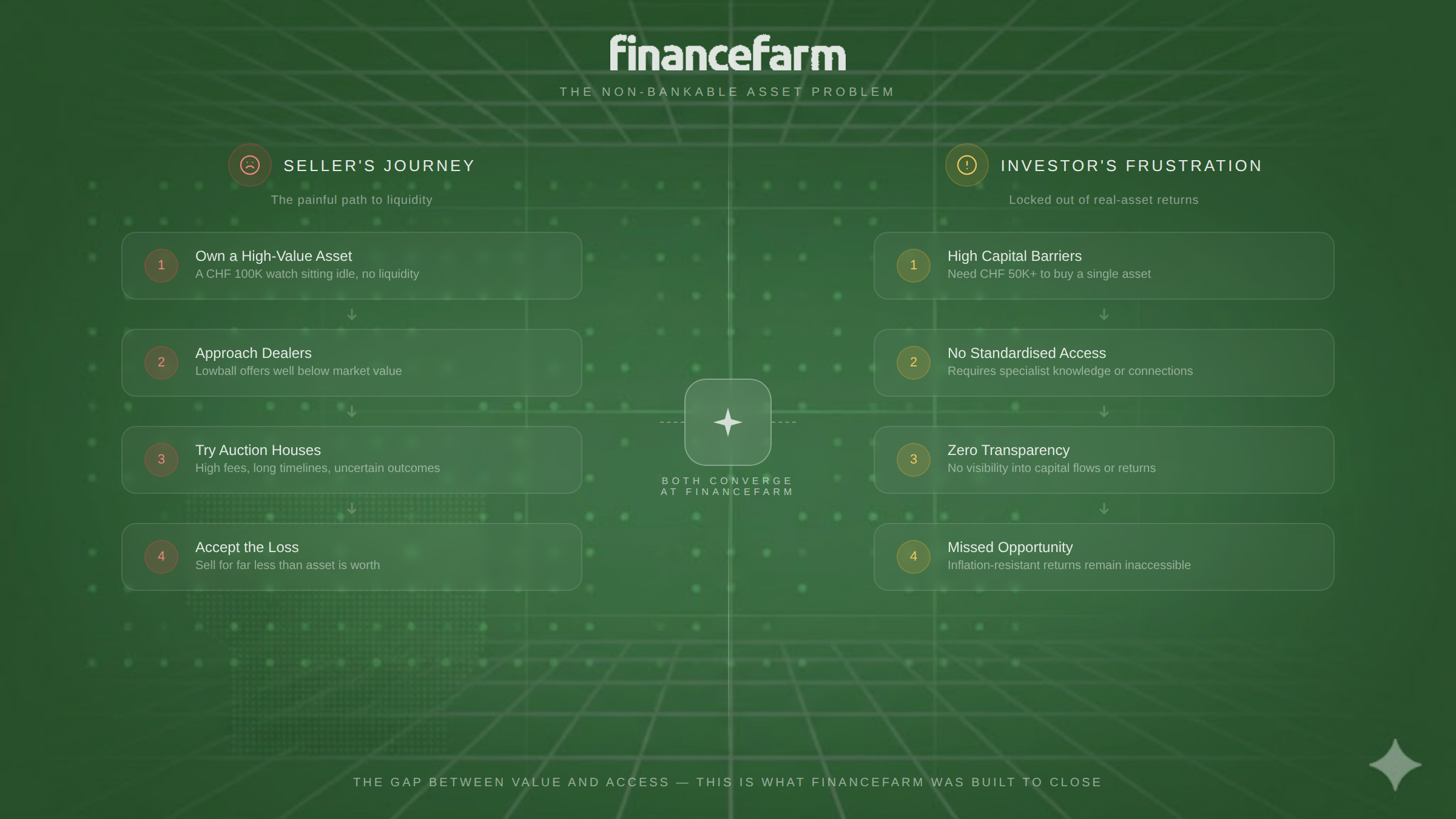
The fundamental issue is infrastructure. There is no single system that handles the entire lifecycle of a non-bankable asset transaction: rigorous valuation, disciplined acquisition, investor participation, market sale, and transparent distribution of returns. This gap between the value locked in these assets and the ability to access it efficiently is exactly what FinanceFarm was designed to close.
Enter FinanceFarm: Complete Lifecycle Infrastructure for Real-World Assets
FinanceFarm is a Swiss fintech platform based in Muttenz that has built the end-to-end infrastructure needed to turn high-value tangible assets into structured, blockchain-verified investment products. The platform connects asset owners who need liquidity with investors who want access to real-world asset returns, and it manages every stage of that connection through a single digital process.
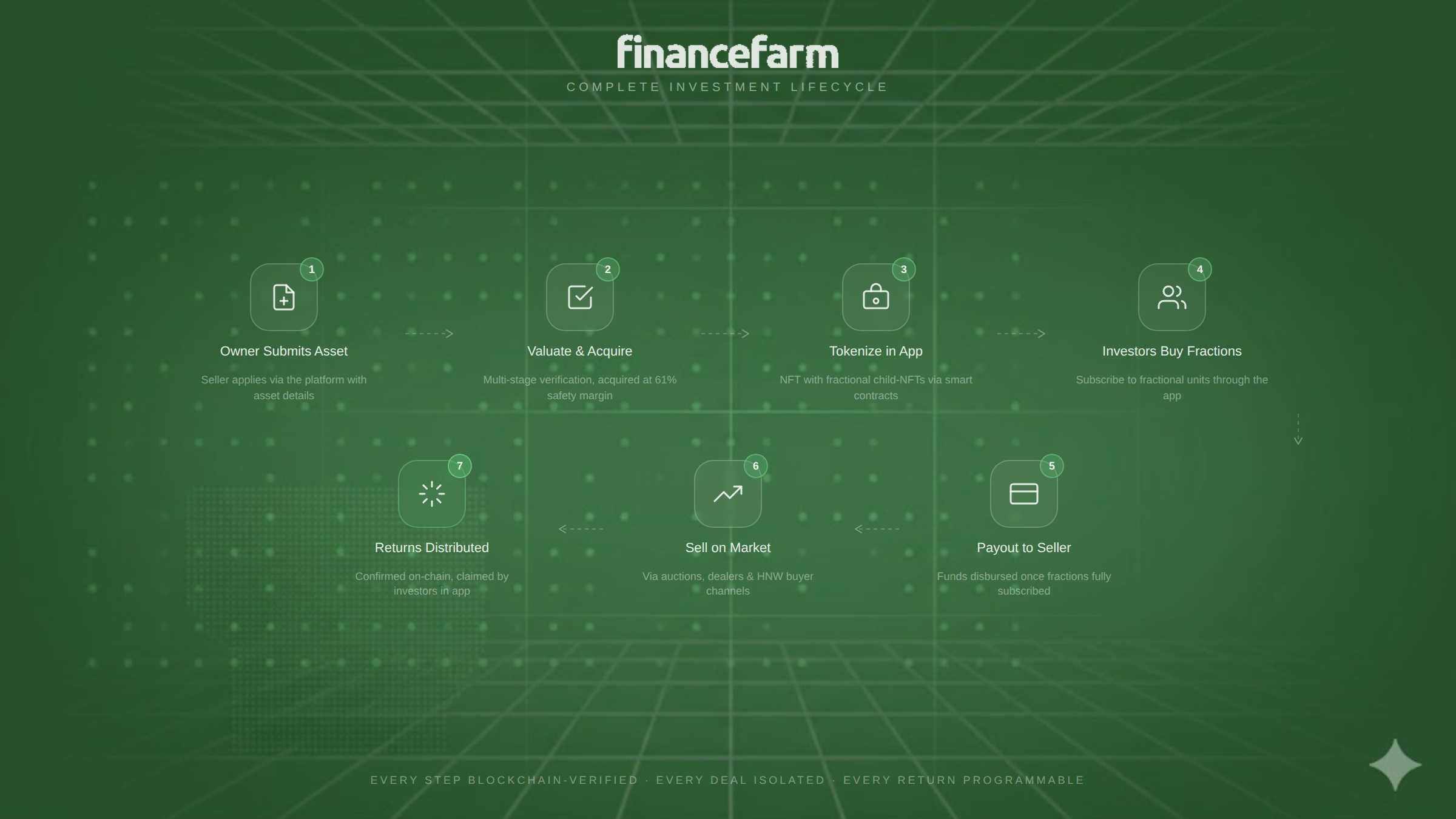
The operational logic can be summarised as follows:
-
Asset owners apply to list their items on the FinanceFarm marketplace when they need liquidity.
-
FinanceFarm conducts rigorous verification of the asset through a multi-stage, evidence-based valuation process examining provenance, condition, transaction history, and relevant market data.
-
FinanceFarm acquires the asset at a significant discount, maintaining a minimum safety margin of 61% compared to the most recently confirmed sale price.
-
The asset is tokenized and listed on the FinanceFarm marketplace. Each asset is represented as an NFT with fractional child-NFT structures, all processed via smart contracts on a blockchain infrastructure.
-
Investors purchase fractions of the asset through the app.
-
Once all fractions are subscribed, FinanceFarm disburses the proceeds to the seller.
-
FinanceFarm then sells the asset on the open market through auction houses, verified partners, and high-net-worth buyers, channels that individual sellers typically cannot access.
-
Returns are distributed to investors once the sale is completed, confirmed on the blockchain, and claimed through the app.
Because FinanceFarm acquires every asset at 61% or more below the last realised sale price, there is a substantial value buffer built into every transaction. Even when selling the asset at or below market value, this margin ensures that both investor returns and platform economics remain healthy.
The Seller Experience: Speed, Certainty, and Access
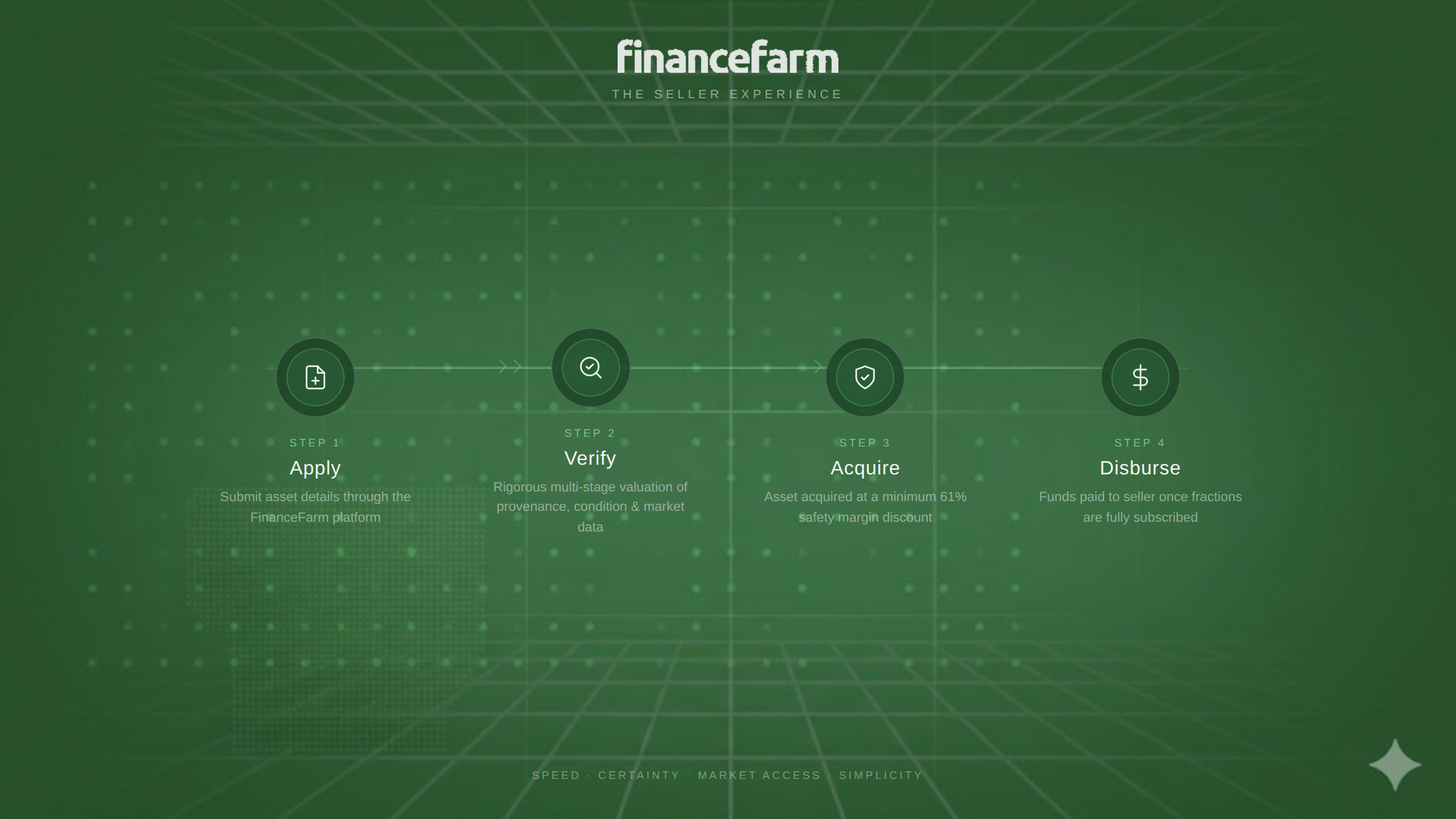
For asset owners, FinanceFarm offers something the traditional market cannot: a formally lean, time-efficient process that converts high-value assets into liquidity quickly and predictably.
Application. The seller applies through the FinanceFarm platform, providing details about their asset, whether it is a luxury watch, fine art, rare collectible, or selected raw material.
Rigorous Verification. Every asset goes through a multi-stage, evidence-based valuation process. FinanceFarm examines provenance, condition, transaction history, and relevant market segments. Auction results, dealer quotes, and comparable transactions are analysed and transferred into a consistent valuation framework. A proprietary valuation application models historical price data, liquidity indicators, volatility regimes, seasonal patterns, transaction costs, and potential exit paths.
Acquisition at a Safety Discount. If the asset passes all checks, FinanceFarm acquires it at a price reflecting a minimum 61% safety margin compared to the most recent confirmed sale price. This disciplined acquisition approach is the foundation of the entire business model.
Disbursement. Once the fractional units are fully subscribed by investors in the app, the funds are disbursed to the seller. No months of waiting for an auction cycle. No chasing buyers. No uncertainty.
The key value proposition for sellers is access. FinanceFarm sells assets through auction houses, verified dealer networks, and high-net-worth buyer channels that most individual sellers simply cannot reach on their own. Combined with the speed and certainty of the digital process, this makes FinanceFarm a compelling alternative to the fragmented, opaque traditional market.
The Investor Experience: Structured Returns with Full Transparency
For investors, FinanceFarm provides structured access to real-world asset returns through a process designed around clarity, safety, and verification.
Browse Available Assets. Investors use the FinanceFarm app to view available investment opportunities. Each listing shows asset details, valuation, investment strategy, expected holding period, and projected returns.
Purchase Fractions. Investors subscribe to fractional units (child-NFTs) of the assets they find compelling. There is no need to buy an entire luxury watch or painting. Fractional ownership makes the asset class accessible at a range of investment levels.
Track Everything in Real Time. Every deal has its own dedicated "cash account" within the app. Inflows and outflows are kept strictly separate from the rest of the company. Investors can see the live status of every deal, including documents, payment progress, and maturities. Push notifications inform investors about sales and distributions.
Receive Returns. When FinanceFarm sells the underlying asset on the open market, the sale payment is recorded in the bank account and confirmed on the blockchain. The investor then triggers their return claim directly in the app. The smart contract automatically allocates the corresponding amount to the investor's wallet.
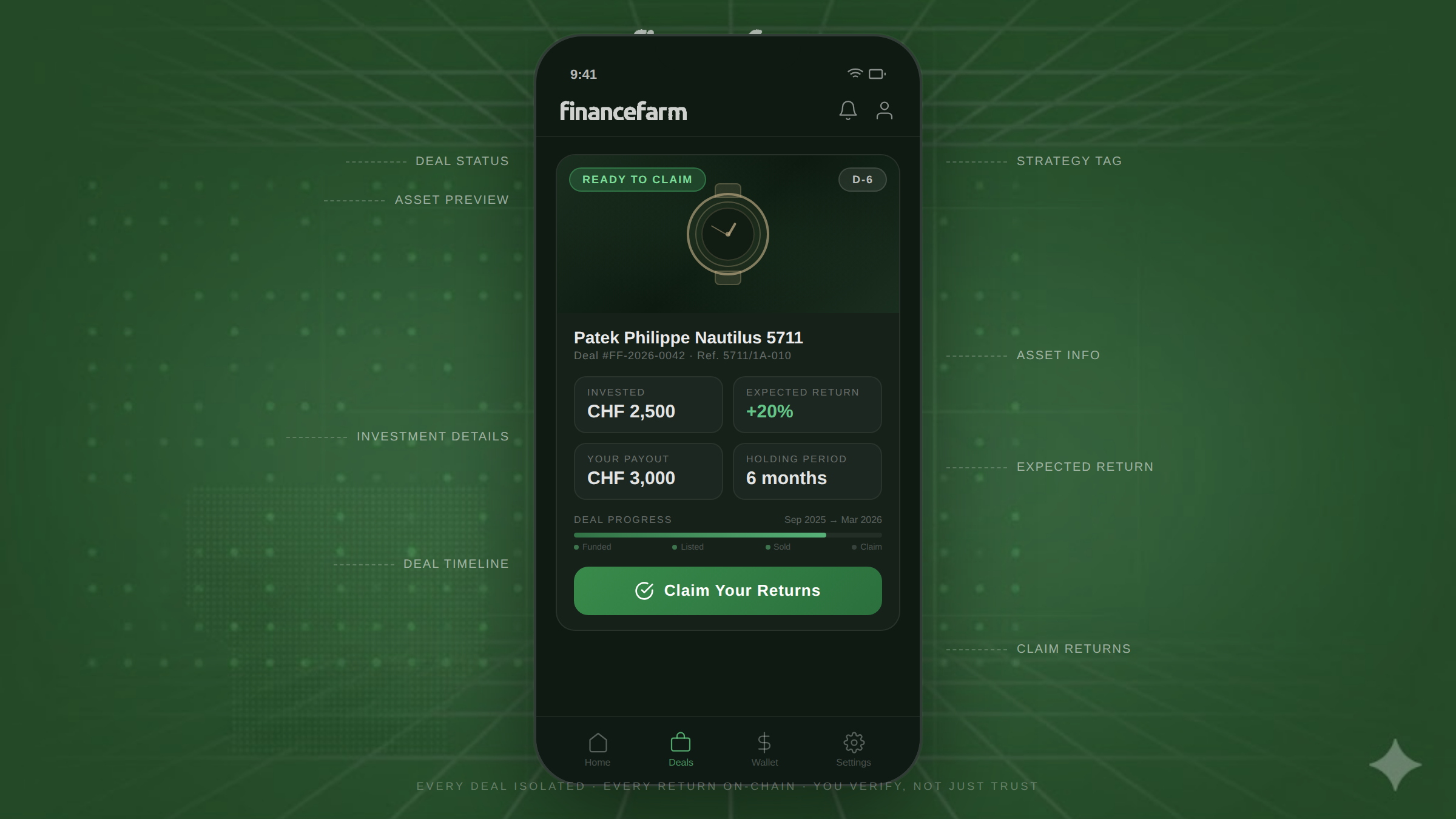
All capital flows are routed through predefined escrow and wallet structures mapped in smart contracts. Distributions only occur once the sale payment has been confirmed both in the bank and on-chain. This is not a promise. It is a programmable, verifiable process.
The Four Rotation Strategies
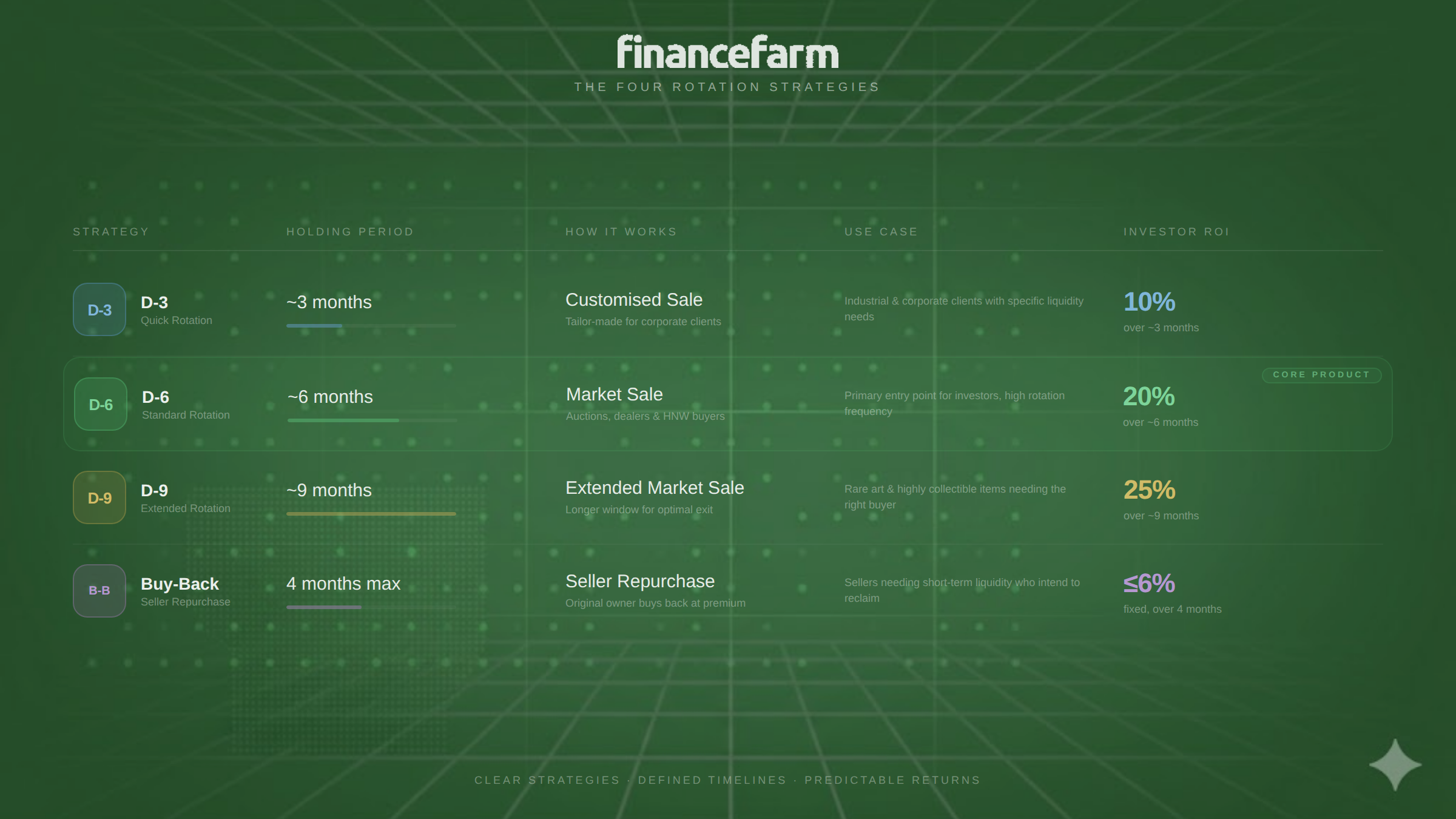
FinanceFarm operates four distinct rotation strategies that define how assets are held, how they are sold, and what returns investors can expect. Each strategy serves a different use case and investor profile.
D-6 Strategy: The Core Product
The D-6 strategy is the standard approach and the one FinanceFarm actively promotes as its entry point for investors. It targets a holding period of approximately six months.
Here is how it works: FinanceFarm acquires the asset at the 61% safety discount, tokenizes it, and investors purchase fractions. Once the subscription is complete, funds are disbursed to the seller. FinanceFarm then sells the asset on the open market, leveraging its network of auction houses, verified partners, and high-net-worth buyers. Because the asset was acquired at a deep discount, FinanceFarm can sell at or even below market value and still generate strong returns.
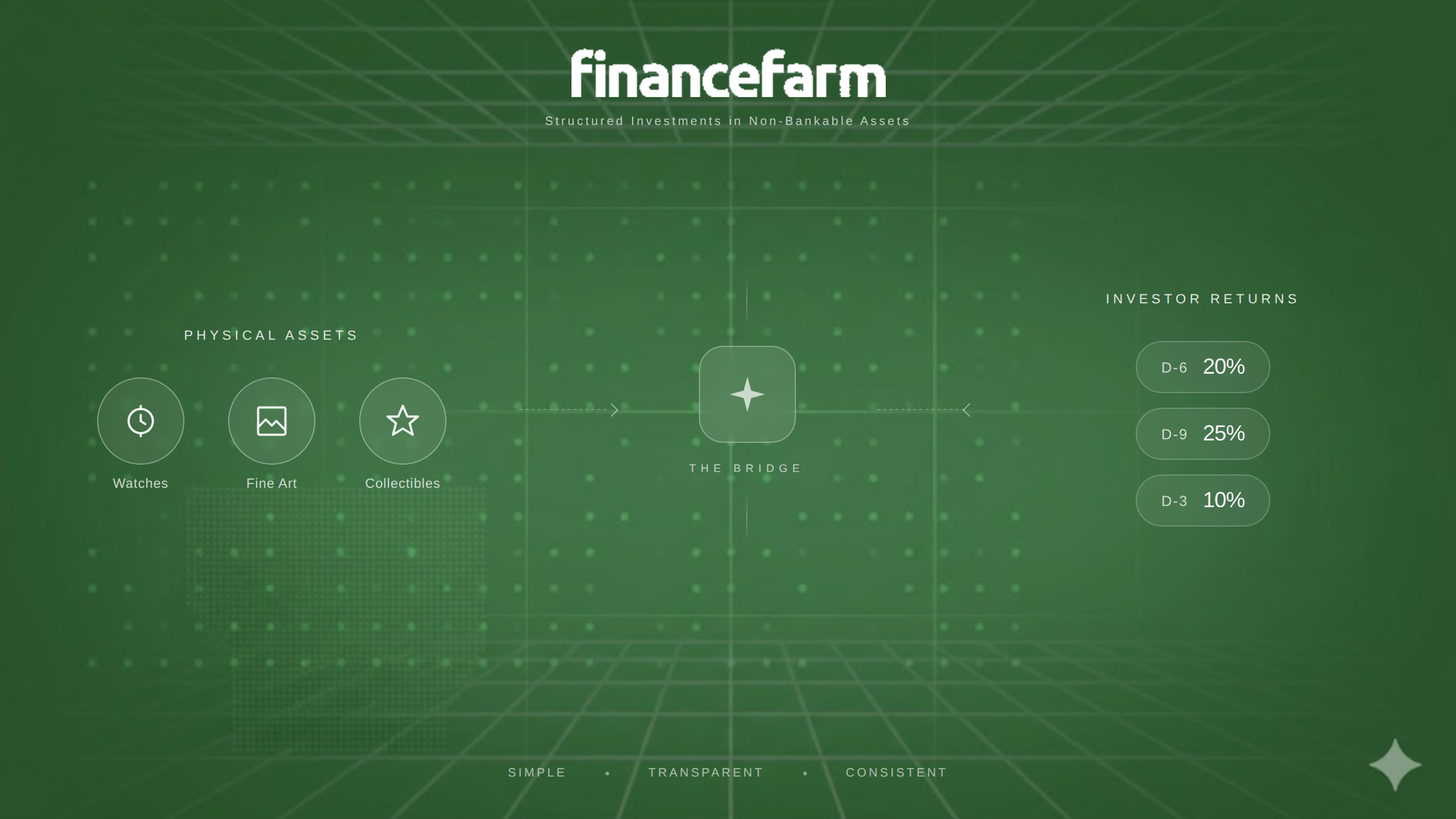
Investor ROI: 20% on the D-6 strategy.
D-6 is the workhorse of the platform. High rotation frequency, predictable timelines, and consistent returns make it the central product in FinanceFarm's model.
D-9 Strategy: For Selected Assets
The D-9 strategy targets a holding period of approximately nine months. It is used selectively for assets where an extended marketing window is economically prudent or where additional absolute margin can be expected. Think of rare art pieces or highly collectible items where identifying the right buyer takes more time but yields a stronger exit price.
Investor ROI: 25% on the D-9 strategy.
Buy-Back Strategy: Seller Repurchase in 4 Months
The Buy-Back strategy works differently from D-6 and D-9. Instead of FinanceFarm selling the asset on the open market, the original seller buys the asset back within a maximum of four months, paying a premium for the temporary liquidity.
This strategy serves sellers who need short-term access to funds but intend to reclaim their asset. For investors, it offers a clearly defined, short-duration return.
Investor return: up to 6% over the four-month period (fixed, no pro rata scaling).
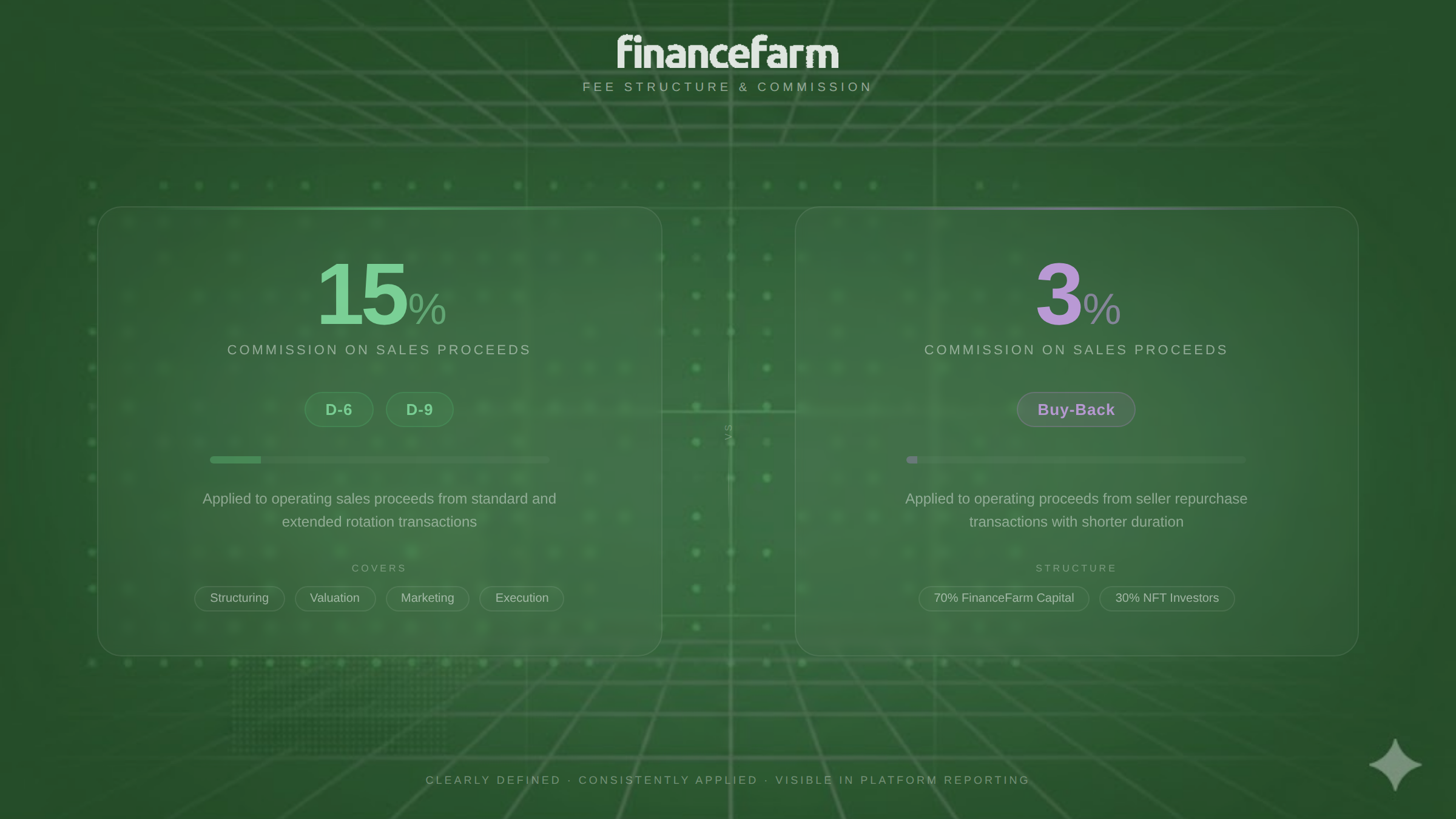
Under this structure, FinanceFarm contributes 70% of the capital employed while NFT investors provide 30%.
D-3 Strategy: Customised Solutions
The D-3 strategy targets a holding period of approximately three months and is designed as a tailor-made solution for industrial and corporate clients with specific liquidity needs. Each D-3 engagement is structured individually in response to the particular requirements of the client and the asset involved.
Investor ROI: 10% on the D-3 strategy.
D-3 adds flexibility to the platform and can generate additional liquidity peaks and revenue streams beyond the standard product offering.
Fee Structure and Capital Split
Transparency extends to how FinanceFarm structures its fees and capital allocation across every transaction.
Commission Structure
FinanceFarm generates commission income from every transaction it facilitates:
15% commission on operating sales proceeds from D-6 and D-9 transactions. This covers the structuring, valuation, marketing, and execution of the asset sale.
3% commission on operating proceeds from Buy-Back transactions.
These commissions are clearly defined, consistently applied, and visible within the platform's reporting structure.
KYC/AML Compliance
All subscriptions are processed through the app in compliance with applicable KYC/AML requirements. If an investor reaches or exceeds USD 1,000 in daily NFT investments, a KYC/AML verification process is automatically initiated before any further investments are enabled.
The 61% Safety Margin: Disciplined Risk Management by Design
If there is one number that defines FinanceFarm's approach, it is 61%.
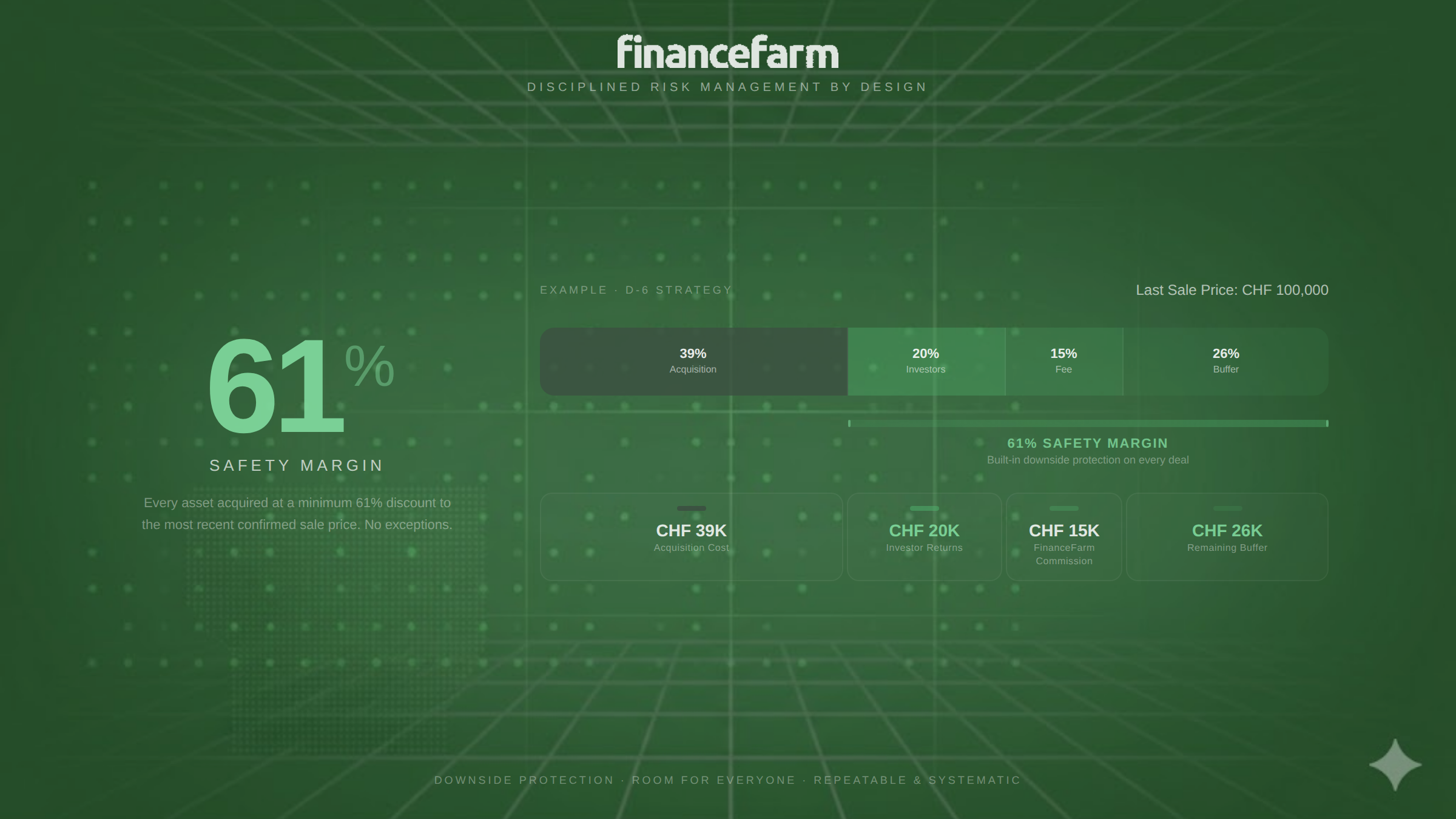
Every asset FinanceFarm acquires must demonstrate a minimum safety margin of 61% compared to the most recent confirmed sale price. In practical terms, if a luxury watch last sold for CHF 100,000, FinanceFarm will only acquire it at CHF 39,000 or less.
This is not aggressive negotiation. It is disciplined risk management embedded into the DNA of the business model.
Here is why this matters:
Downside protection for investors. Even if market conditions shift or the final sale price comes in lower than expected, there is a substantial buffer protecting investor capital and returns.
Room for everyone to benefit. After acquiring at the safety discount, FinanceFarm sells the asset at or near market value. The spread between acquisition cost and sale price covers investor returns, platform commissions, and still leaves margin. The system is designed so that every participant in the transaction benefits.
Repeatable and systematic. This is not a one-time strategy. Every single acquisition follows the same rule. No exceptions. This makes returns predictable and the risk profile manageable across the entire portfolio.
The valuation process itself is multi-stage and evidence-based. FinanceFarm uses a proprietary valuation application that models historical price data, liquidity indicators, volatility regimes, seasonal patterns, transaction costs, and potential exit paths. This operates exclusively in the back end, fully decoupled from the front end, and constitutes a core trade secret of the platform.
Blockchain Transparency: Trust You Can Verify
One of the most common concerns in alternative investing is straightforward: "Where is my capital, and what is happening with it?"
FinanceFarm answers this question with radical transparency powered by blockchain technology.
Every step gets a timestamp. Purchase price, costs, sales proceeds, and returns all receive an on-chain timestamp and are recorded immutably. Nobody can alter the record after the fact.
Every deal is isolated. Each investment has its own dedicated account. Inflows and outflows are kept strictly separate from the rest of the company. It is always transparent which funds were used for what and which proceeds belong to which deal.
Payments are confirmed before distributions. Distributions to investors only occur after the sale payment has been recorded in the bank account AND confirmed on-chain. No exceptions.
Investors claim their own returns. Through the app, investors actively trigger their return claims. The smart contract automatically allocates the funds to their wallet. There is no waiting for manual processing.
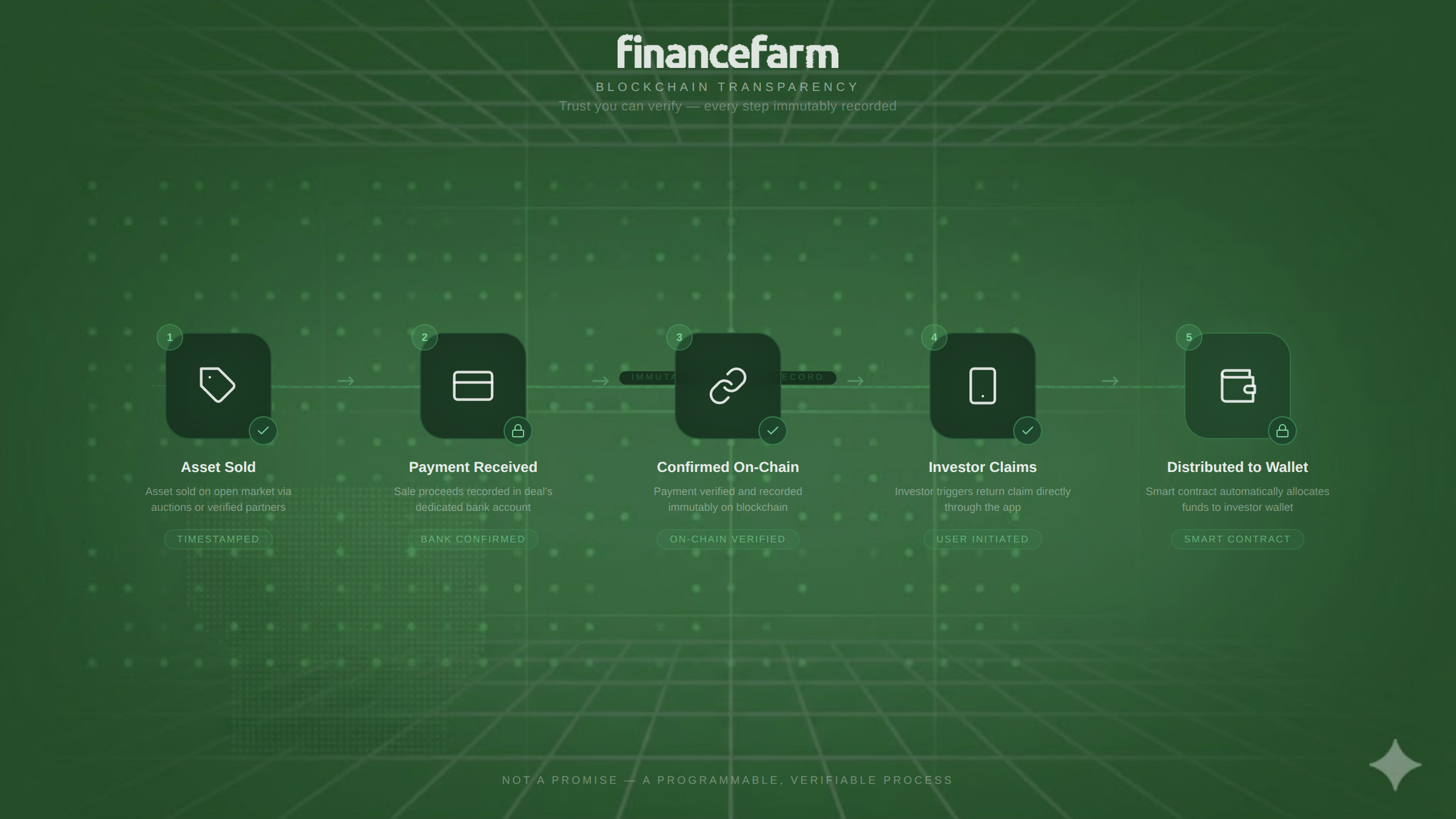
All critical processes are executed via smart contracts on an EVM-compatible blockchain. This includes the issuance of NFT and child-NFT structures, the subscription of participations, the lock-up status during the holding period, the execution of the exit, and the subsequent distribution to investors. Comprehensive logging records all relevant transactions with timestamps, the wallets involved, and the associated smart-contract events.
This level of transparency is not common in alternative investments. Most platforms ask you to trust them. FinanceFarm lets you verify.
Who Is FinanceFarm For?
For Asset Owners Who Need Liquidity
If you own high-value tangible assets and need to convert them into funds:
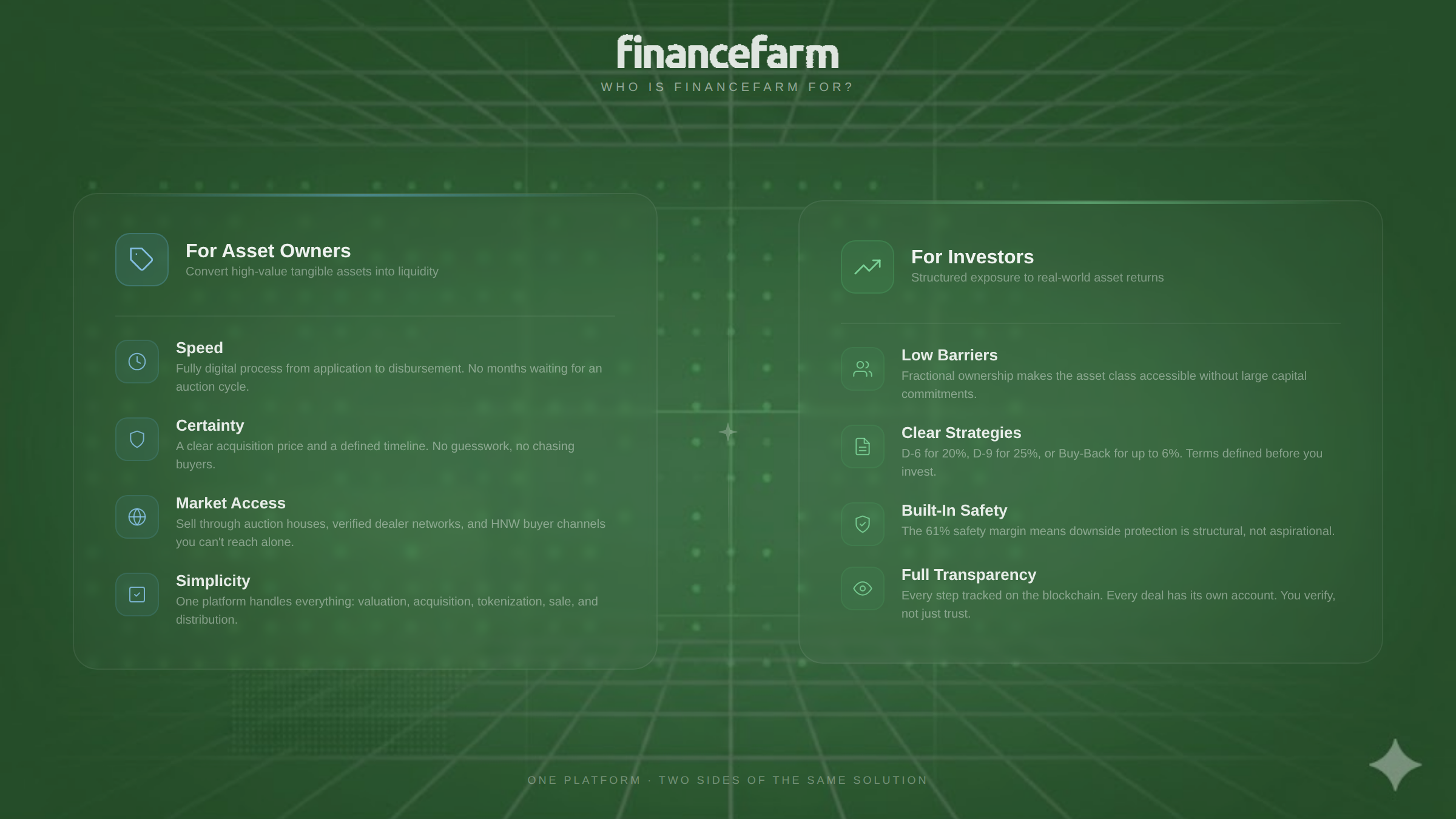
Speed. A fully digital process from application to disbursement. No months of waiting for an auction cycle.
Certainty. A clear acquisition price and a defined timeline. No guesswork.
Market access. FinanceFarm sells through auction houses, verified partner networks, and high-net-worth buyer channels that individual sellers typically cannot reach.
Simplicity. One platform handles everything: valuation, acquisition, tokenization, sale, and distribution.
For Investors Who Want Real-Asset Returns
If you want structured exposure to tangible, real-world assets:
Low barriers. Fractional ownership makes the asset class accessible without large capital commitments.
Clear strategies. Choose D-6 for 20% ROI over six months, D-9 for 25% over nine months, or Buy-Back for up to 6% over four months. The terms are defined before you invest.
Built-in safety. The 61% safety margin means downside protection is structural, not aspirational.
Full transparency. Every step is tracked on the blockchain. Every deal has its own account. You verify, not just trust.
The Road Ahead
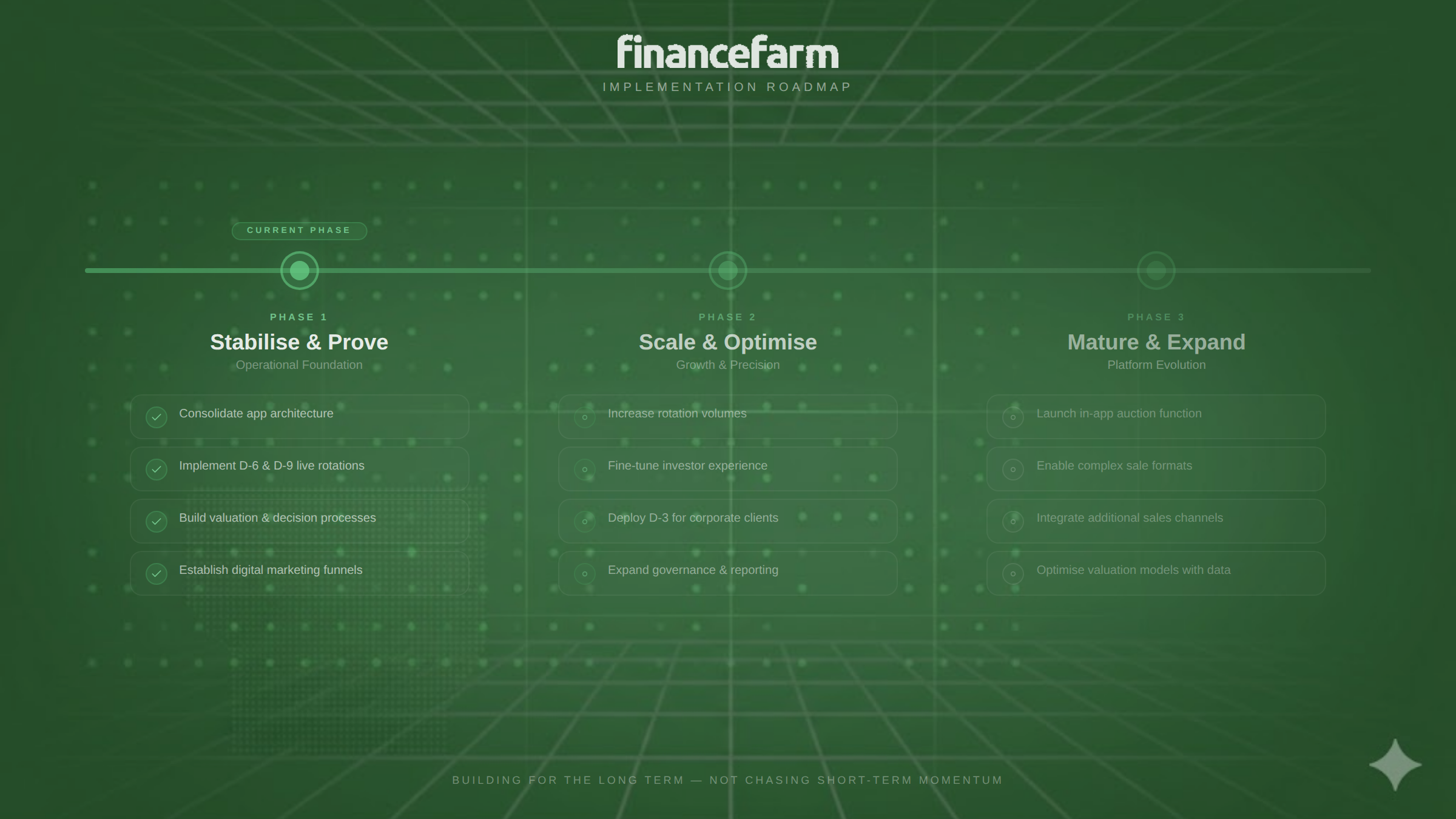
FinanceFarm's implementation roadmap is built around three phases that move progressively from foundation to scale.
Phase 1: Operational Stabilisation. The immediate priority is consolidating the app architecture, fully implementing D-6 and D-9 rotations in live operation, building robust valuation and decision-making processes, and establishing digital marketing funnels. The objective is to deliver a reliable proof of execution and complete the first cycles with high process quality.
Phase 2: Scaling and Optimisation. The emphasis shifts to increasing rotation volumes, fine-tuning the investor experience, and selectively deploying D-3 solutions for corporate clients. Governance and reporting structures expand so that cohort-based management gains precision with each additional rotation.
Phase 3: Maturation and Expansion. The in-app auction function launches, enabling more complex formats within the existing system. Additional sales channels become economically attractive and can be integrated without compromising the stability of core processes.
Throughout this journey, building a robust data base is a key theme. Only with sufficient data history across multiple cycles can valuation models, risk limits, and marketing approaches be optimally calibrated. FinanceFarm is building for the long term, not chasing short-term momentum.
Why Now?
Several macro trends are converging that make FinanceFarm's timing particularly compelling.
Alternative assets have gone mainstream. Investors increasingly seek diversification beyond equities and bonds. Tangible assets offer a hedge against inflation and market volatility that purely financial instruments cannot match.
Tokenization technology is mature. The infrastructure to represent real-world assets as digital tokens on a blockchain is proven, secure, and scalable. What was experimental five years ago is now production-ready.
Transparency is non-negotiable. After years of opacity in traditional finance and high-profile failures in the digital asset space, investors demand radical transparency. They want to see where their capital is, what is happening with it, and when returns will be distributed. FinanceFarm delivers this by design.
The non-bankable asset gap is massive. Trillions in value sit in assets the traditional financial system ignores. This is not a niche market. It is a structurally underserved one.
FinanceFarm sits at the intersection of all these forces. It is not selling a vision of the distant future. It is providing a practical, operational platform that turns a massive market inefficiency into a structured investment product.
If you are looking for a clear, data-driven, and operationally robust solution for investments in real assets, FinanceFarm is your partner: easy to understand, rigorous in execution, and designed to recycle capital efficiently.
FinanceFarm AG, Muttenz, Switzerland. Structured investments in non-bankable assets. Simple. Transparent. Consistent.

Comments ()
No comments yet
Be the first to share your thoughts!