
The Safety Margin: How FinanceFarm's Acquisition Discipline Protects Every Co-Ownership Share
The global market for non-bankable assets is large, active, and anything but stable. The global art market alone reached an estimated USD 57.5 billion in 2024 across 40.5 million transactions. Luxury watches appreciated 125.1% over the past decade, outperforming most traditional asset benchmarks. Yet the same markets that deliver sustained appreciation can also correct sharply over short windows.
This is why, before any non-bankable asset appears in the FinanceFarm app, it has already passed through one of the strictest filters in alternative co-ownership. We call it the safety margin. It is the single most important mechanism that separates disciplined acquisition from speculative buying, and it sits at the core of how we protect every co-participant who joins a round.
This article explains what the safety margin is, how it works in practice, and why it matters for anyone considering structured co-ownership of luxury watches, fine art, collectibles, or raw materials.
What Is the Safety Margin?
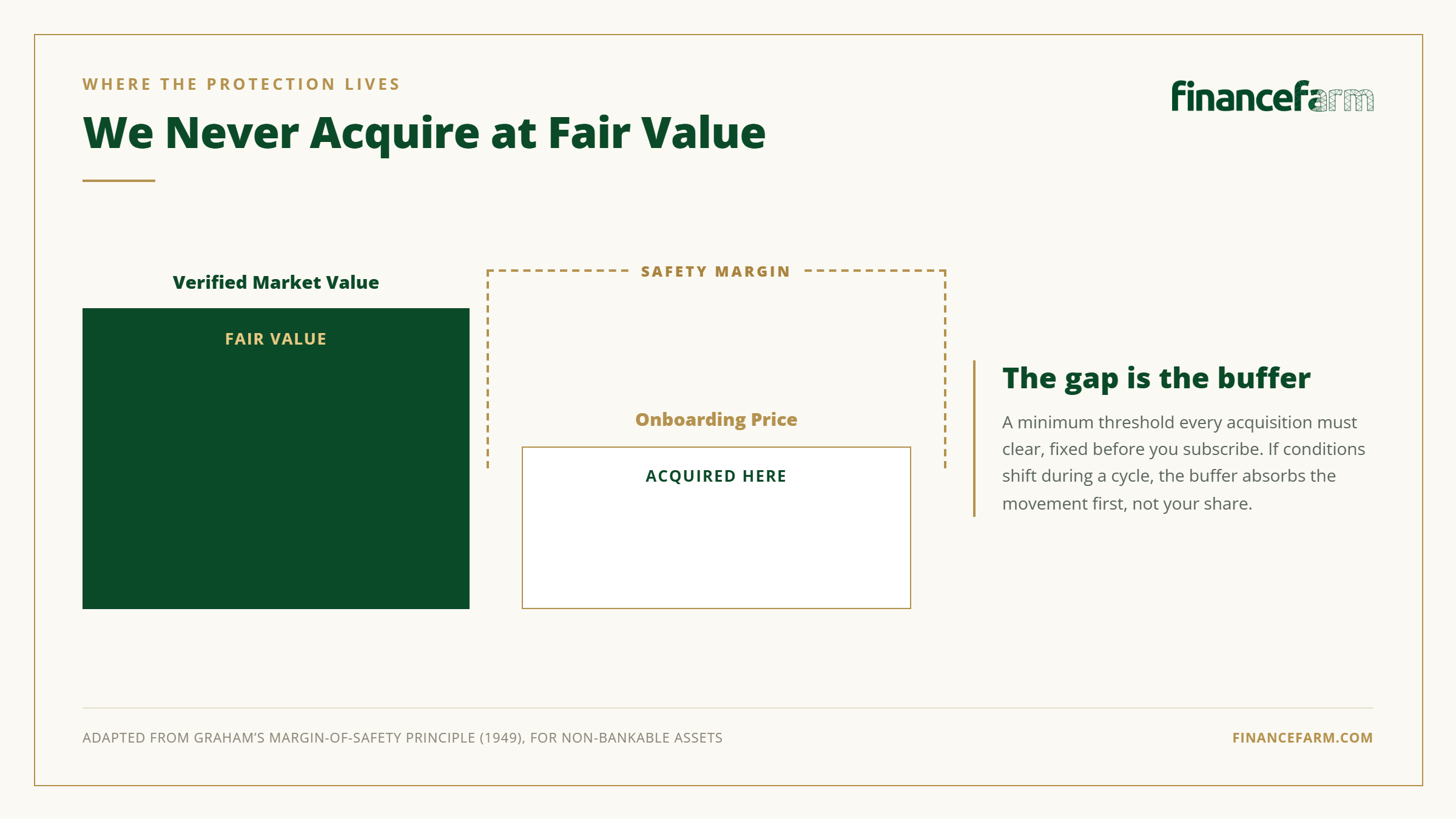
The safety margin is the gap between the price at which FinanceFarm agrees to acquire a non-bankable asset and what that asset is actually worth on the open market.
The margin of safety principle has been foundational to disciplined finance since Benjamin Graham articulated it in 1949. We have adapted it for the non-bankable asset context, where verified sale prices replace public market quotations as the benchmark of fair value.
Put simply: we never acquire at fair value. We only onboard assets significantly below their last verified sale price. That discount is not optional. It is a minimum threshold that every potential acquisition must clear before the asset is brought onto the platform.
Think of it as a buffer that sits underneath every co-ownership share. If market conditions shift during the rotation cycle, the buffer absorbs the movement before it ever reaches the co-participants who hold shares in that asset.
How the Safety Margin Works in Practice
Every non-bankable asset we consider goes through a structured evaluation process before we commit to an acquisition.
First, our acquisition team identifies the last verified sale price for the specific asset. For a luxury watch, this means recent auction results for the exact reference and condition grade. For fine art, it means documented secondary market sales of comparable works by the same artist, drawn from verified auction records and major art market research sources. For collectibles and raw materials, it means verified transaction records from recognized marketplaces and dealers.
Second, we independently appraise the asset to confirm its current market value. This is done through qualified third parties with no commercial stake in the acquisition.
Third, we calculate the maximum acquisition price that would still satisfy our safety margin requirement. If a seller will not transact at or below that price, we walk away. No exceptions.
Only non-bankable assets that clear this threshold ever make it onto the platform. Everything else is filtered out before co-participants ever see it.
Why the Safety Margin Matters for Co-Participants
Markets move. Prices fluctuate. That is true for every asset class, and non-bankable assets are no exception. The Art Basel and UBS Global Art Market Report 2025 recorded a 12% drop in global art sales in 2024, and the Knight Frank Luxury Investment Index fell 3.3% in the same year despite strong performance over the decade.
The safety margin is what allows us to offer structured access to these assets with a defensive layer already built in. Because every acquisition starts well below fair value, co-participants are protected from market shifts that would otherwise erode the value of their shares.
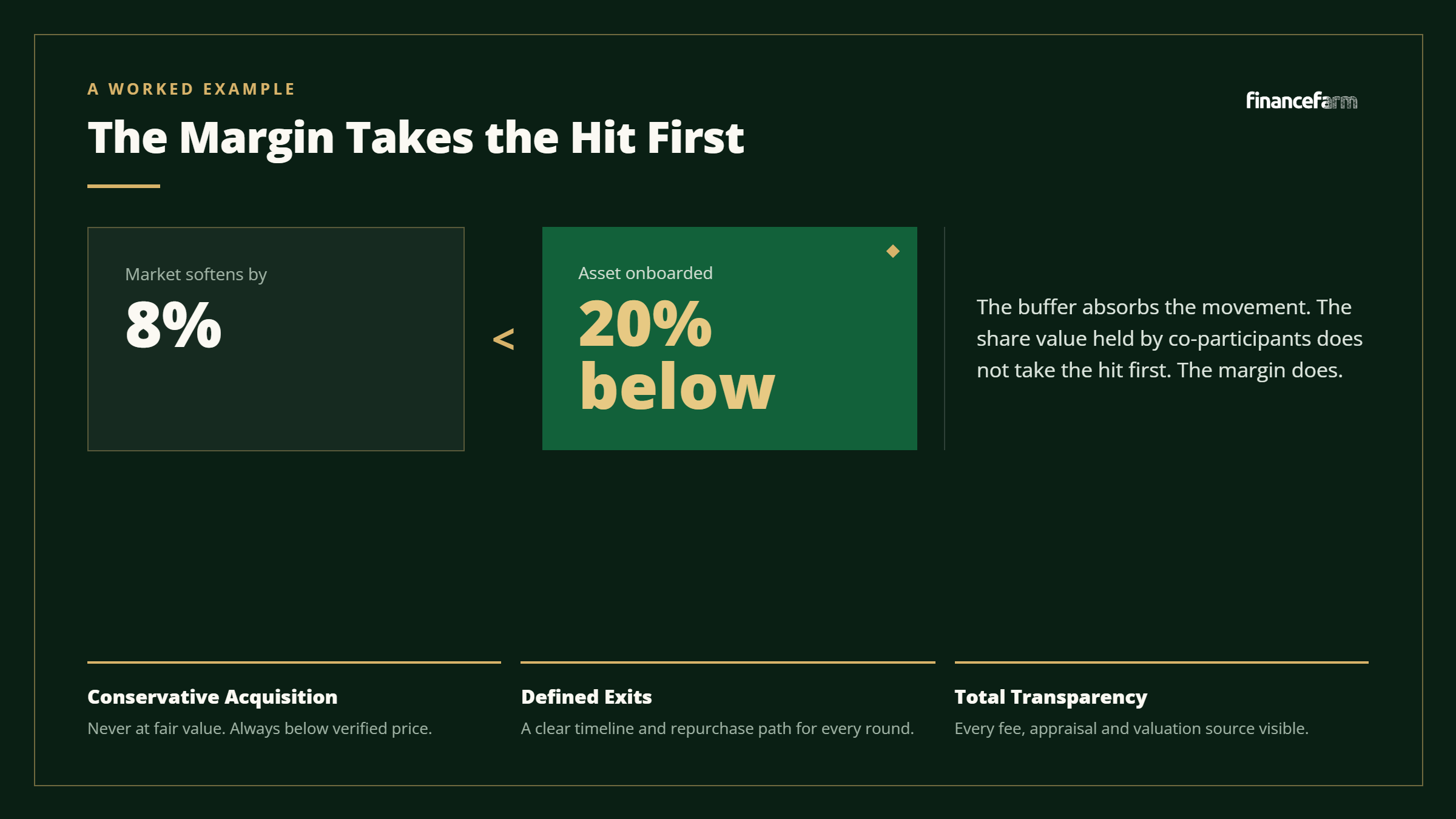
If the market for a particular watch reference softens by 8% during a rotation cycle, but the asset was onboarded 20% below its verified sale price, the buffer absorbs the movement. The share value held by co-participants does not take the hit first. The margin does.
This is what we mean when we talk about structural protection. It is not a guarantee, and we never pretend it is. It is a disciplined design choice that puts distance between market noise and the people who participate in each round.
The Rigorous Filter Behind Every Acquisition
A lot of asset platforms talk about curation. What we do is different. Curation is about taste. The safety margin is about math.
Every deal that lands on FinanceFarm has survived a process that rejects far more opportunities than it accepts. Assets that look attractive on the surface but cannot be acquired at the required discount are declined. Assets with soft provenance, unclear documentation, or pricing that does not reflect verified sales history are declined.
What remains is a smaller, higher quality pool of non-bankable assets that meet our standard. Luxury watches with clean service records, onboarded below recent comparable sales. Fine art with documented provenance, acquired below dealer and auction benchmarks. Collectibles and raw materials with verifiable transaction history and pricing that leaves room for the buffer.
This is why the safety margin is not a marketing phrase. It is a filter. And most of what gets looked at never makes it through.
Conservative Acquisition, Defined Exits, Total Transparency
The safety margin is one half of the FinanceFarm model. The other half is what happens after acquisition: defined exits and full transparency about how each rotation cycle is structured.
Every co-ownership round has a clear timeline. Every non-bankable asset has a defined path to repurchase or onward sale. Every fee, every appraisal, and every valuation source is visible to co-participants who join a round.
That is the discipline behind every deal we bring to the platform. Conservative acquisition. Defined exits. Total transparency.
Structural protection, built into every acquisition. That is the FinanceFarm standard.
Sources
- Art Basel & UBS. The Art Basel and UBS Global Art Market Report 2025, authored by Dr. Clare McAndrew, Arts Economics. artbasel.com
- Knight Frank. The Wealth Report 2025, Luxury Investment Index. knightfrank.com/wealthreport
- Investopedia. Margin of Safety: Definition, Principle, Example. investopedia.com
Comments ()
No comments yet
Be the first to share your thoughts!