
Sell a Luxury Asset Discreetly, Without Going to Auction
What an Auction Makes Public
Consigning to auction means publication. The work appears in a catalogue with its description, estimate and provenance. It is exhibited before the sale. Bidding happens in the open, and the result is announced whether it flatters the seller or not.
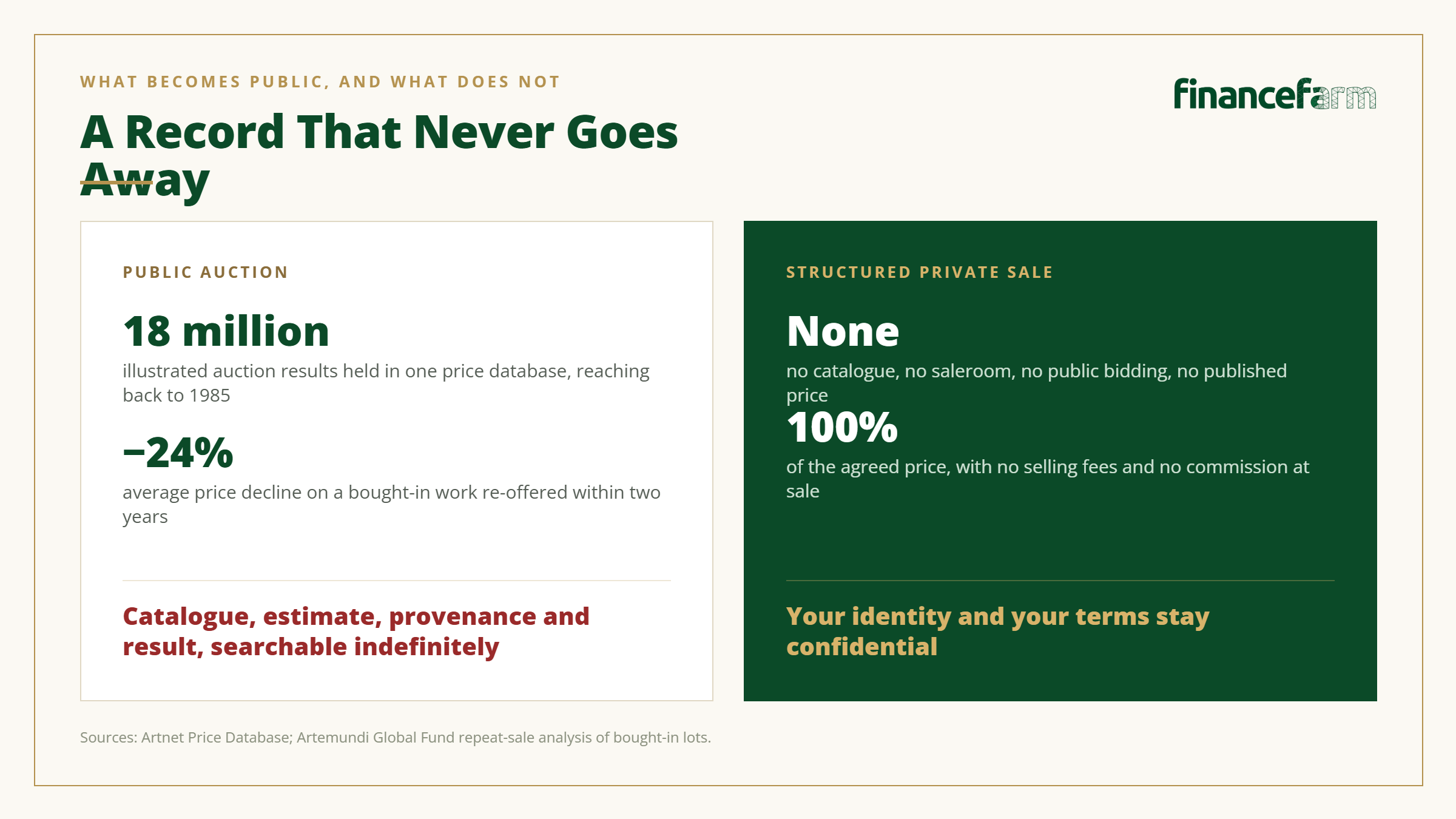
That result then outlives the evening. The Artnet Price Database alone holds around 18 million illustrated auction results reaching back to 1985, updated daily. Once an object has crossed an auction block, the event is searchable by anyone, indefinitely: the price, the date, and often the provenance that names where it came from.
For some sellers that is acceptable. For an inheritance, a family transition, a business exit, or plain personal privacy, it is not.
The Price of a Public Miss
An auction is not only public when it succeeds. If the reserve is not met, the lot is bought in, and the trade calls the work "burned": publicly offered, publicly declined.
The damage is measurable. An analysis of repeat auction records found that a bought-in work re-offered within two years sells for roughly a third less than its estimate, with an average price decline of about 24 percent, and that the drag on value fades only after about five and a half years. The record of the failure follows the object.
The Quiet Shift Toward Private Sales
The market has drawn its own conclusion. Even the major auction houses now run large private-sale operations: Christie’s grew private sales from USD 800 million in 2019 to USD 1.5 billion in 2025, roughly a quarter of its revenue, while Sotheby’s reached USD 1.2 billion the same year. In 2024, private sales rose 41 percent at Christie’s and nearly 20 percent at Sotheby’s.
The reasons are consistent: wealthy sellers increasingly prefer discreet transactions for security and personal reasons, and nobody wants a public stumble on the block. Discretion has become a feature buyers of certainty pay attention to.
What Discretion Means in a Structured Private Sale
At FinanceFarm, the sale is private by design. There is no public auction, no catalogue, no bidding and no public price formation. Your identity and the terms of your sale remain confidential, and one personal contact carries the entire process from first review to payout.
One thing we say plainly, because trust depends on it: after FinanceFarm acquires an asset, the asset is presented on the FinanceFarm platform to registered co-participants. What stays confidential is you and your sale: your identity, your documents, and the terms you agreed. Discretion attaches to the seller, not to a pretence that the object vanishes.
FinanceFarm AG has its seat in Switzerland and operates under Swiss law.
Privacy at Every Step
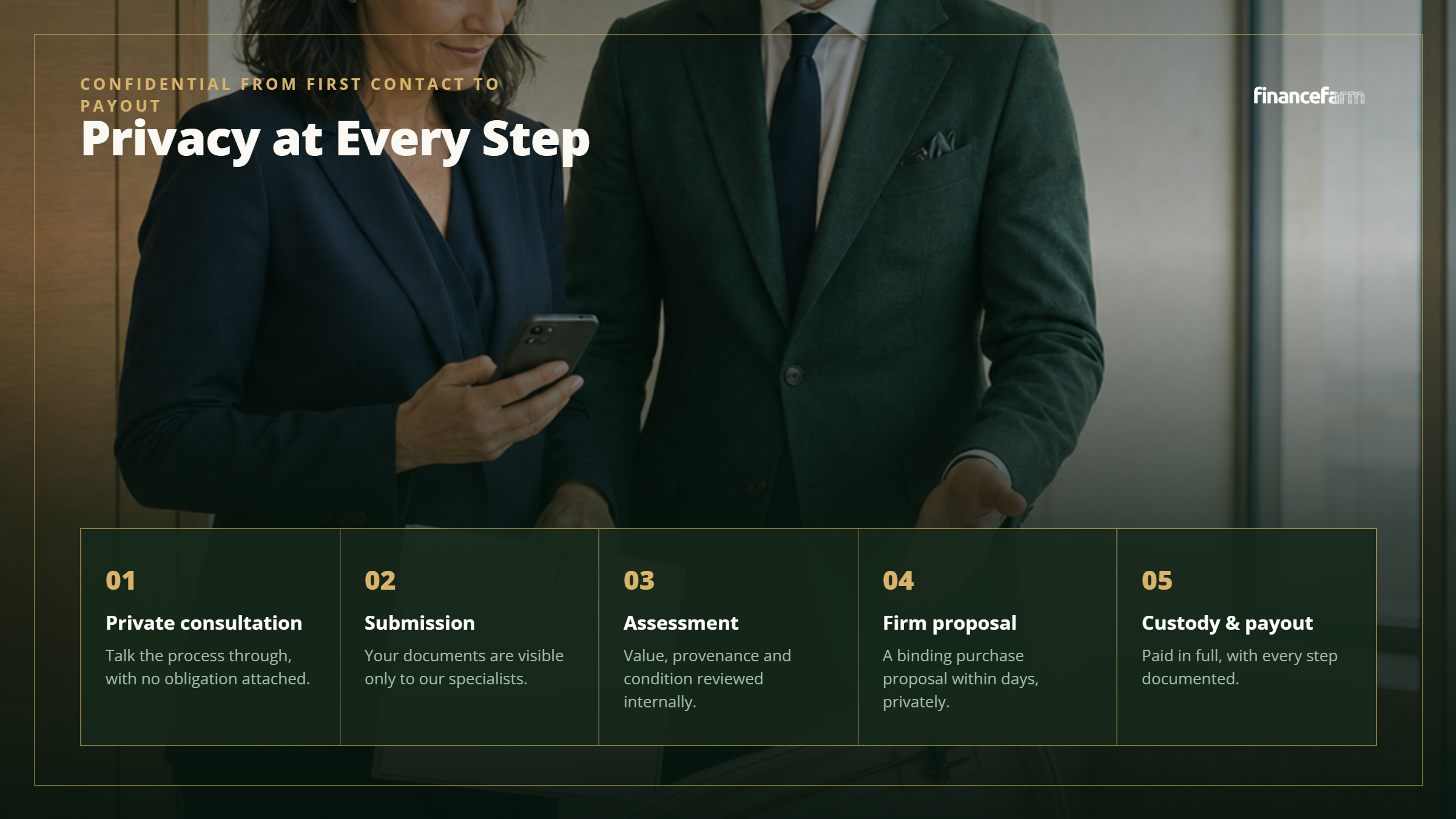
01 Private consultation. Before anything is submitted, you can talk the process through for your specific asset. No obligation attached.
02 Submission. You register and submit the asset with photographs and the paperwork you hold. Your documents are visible only to our specialists.
03 Assessment. Value, provenance and condition are reviewed internally and documented. FinanceFarm acquires objects from a market value of CHF 50 000 per object, and an asset that cannot be assessed with confidence does not proceed.
04 Firm proposal. Within days you receive a binding purchase proposal, privately. No selling fees at sale, no commission, 100 percent of the agreed price.
05 Custody and payout. The asset moves into FinanceFarm’s custody, the agreed price is paid in full, and every step of the transaction is documented.
Frequently Asked Questions
Is anything about my sale made public?
There is no auction, no catalogue, no public bidding and no published price record. After acquisition the asset is presented on the FinanceFarm platform to registered co-participants; your identity and your terms are not part of that presentation.
Who sees my documents?
Our specialists, for the purpose of assessing value, provenance and condition. Nothing you submit is published.
Do I have to deal with buyers?
No. One personal contact carries the process from first review to payout.
What does the seller receive?
A firm purchase proposal within days, no selling fees at sale, and 100 percent of the agreed price.
Start seller onboarding: financefarm.com/become-seller · www.financefarm.com
References
• Artnet Price Database. artnet.com www.artnet.com
• Artemundi Global Fund. “Is an artwork ‘burnt’ by failing to sell at a public auction?” (repeat-sale analysis of bought-in lots). artemundiglobalfund.com
• MyArtBroker. “How the Art Auction Process Actually Works.” www.myartbroker.com
• The Art Newspaper. “Christie’s and Sotheby’s end 2025 with increased sales, thanks to luxury goods, trophy lots and private deals.” December 2025. www.theartnewspaper.com
• ARTnews. “Private Sales Are Surging as Auction Houses Lean into Exclusive, Experience-Led Selling.” www.artnews.com
• CNBC. “‘Quiet wealth’ takes on new meaning with super-private deals for mansions, art and classic cars.” May 2024. www.cnbc.com
• Swiss Civil Code of 10 December 1907 (SR 210), Fedlex, Federal Council of Switzerland. www.fedlex.admin.ch
FINANCEFARM AG · SWITZERLAND · LIQUIDITY FOR NON-BANKABLE ASSETS
This content is for informational purposes only and does not constitute financial advice. All participation in co-ownership carries risk.
Comments ()
No comments yet
Be the first to share your thoughts!