
Structured Co-Ownership Explained: How One Asset Can Belong to Several Owners
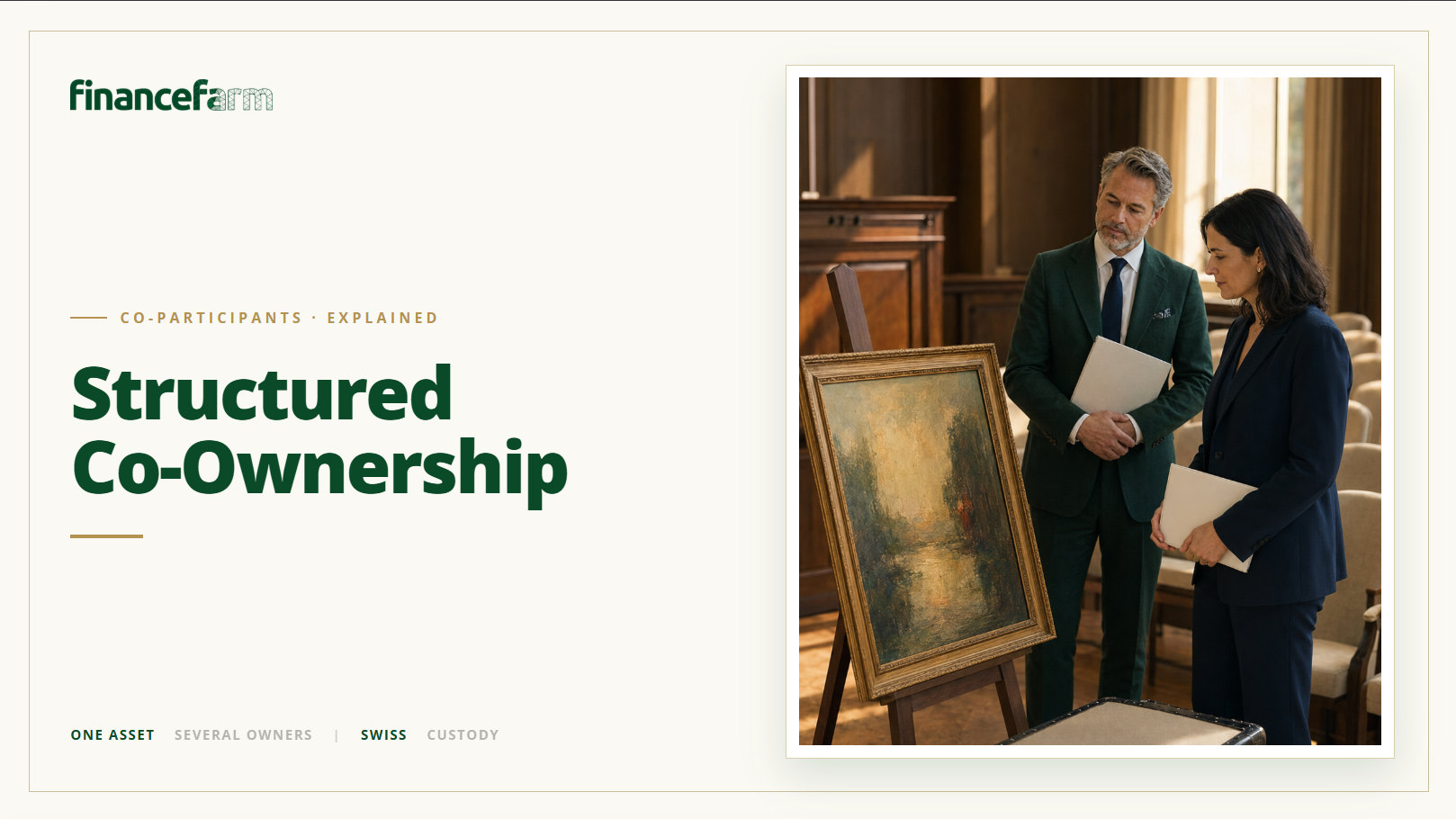
Structured co-ownership lets more than one participant co-own a single high-value asset. Here is how it works under Swiss law, with secure custody and transparent documentation at every step.
What Structured Co-Ownership Means
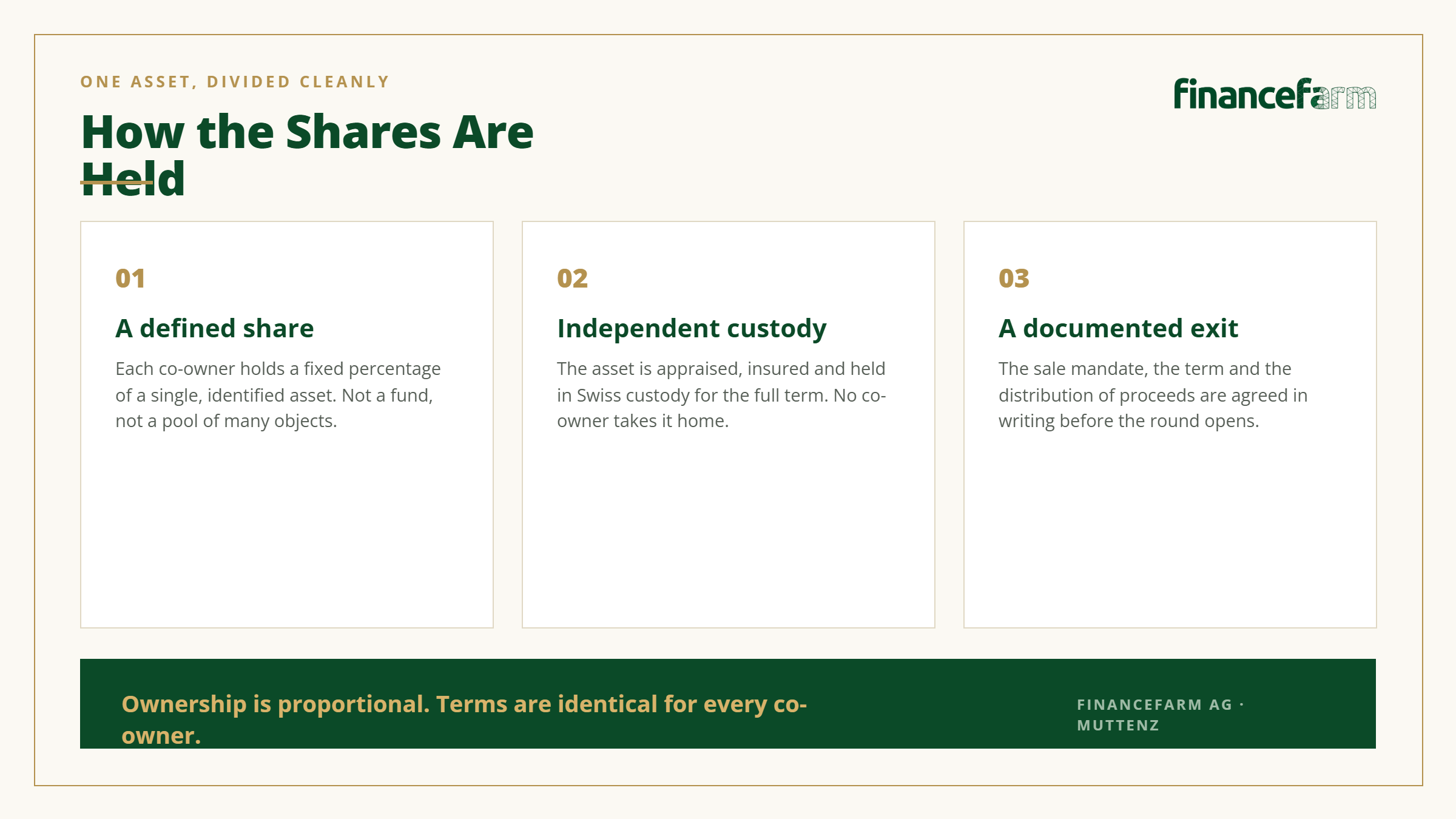
Structured co-ownership is an arrangement in which several participants together own one physical asset. Each holds a share of the ownership in the asset itself.
The asset is never physically divided. A painting is not cut, a watch is not taken apart. The object stays whole, in one place, in FinanceFarm’s custody. What is shared is the ownership.
Participants acquire genuine ownership in the asset as it already exists. Each co-owner’s share is set out in the contractual documentation, and the asset itself remains one physical object in FinanceFarm’s custody.
Why Non-Bankable Assets Need a Structure Like This
Fine art, luxury watches and rare collectibles are described as non-bankable for a simple reason: they hold real value, but the banking system is not built to hold them. Ultra-high-net-worth individuals held an estimated US$2.564 trillion in art and collectible wealth in 2024, up from US$2.174 trillion in 2022, a figure projected to reach around US$3.473 trillion by 2030. Ultra-high-net-worth collectors allocate an average of 10.4 percent of their total wealth to art and collectibles.
That is a very large amount of value sitting in a form that is difficult to move. Some banks decline to offer art-secured lending altogether, because of the inherent difficulty of valuing and authenticating works and because of their moveable nature. Where art-secured lending is available, the loan-to-value ratio is typically between 40 and 60 percent, and lenders generally prefer borrowers with an existing relationship or additional collateral.
A single object worth several hundred thousand francs has, in practice, one possible buyer at a time. Structured co-ownership changes that arithmetic by allowing participation at the level of a share rather than the whole.
Swiss Law Has Recognised Co-Ownership for Over a Century
Structured co-ownership is not a new legal idea. It rests on a principle written into Swiss law in 1907. Article 646 of the Swiss Civil Code states that co-ownership exists where several persons own a share in an object which is physically undivided, that unless otherwise stipulated they are co-owners in equal measure, and that each co-owner has the rights and obligations of ownership in respect of his or her share in the object.
Three things follow from that, and they are the foundation of everything FinanceFarm builds on the seller side. The object stays undivided. Each share carries real ownership rights. And a share of ownership can be held and transferred like any other property right.
How a Single Asset Comes Into Co-Ownership
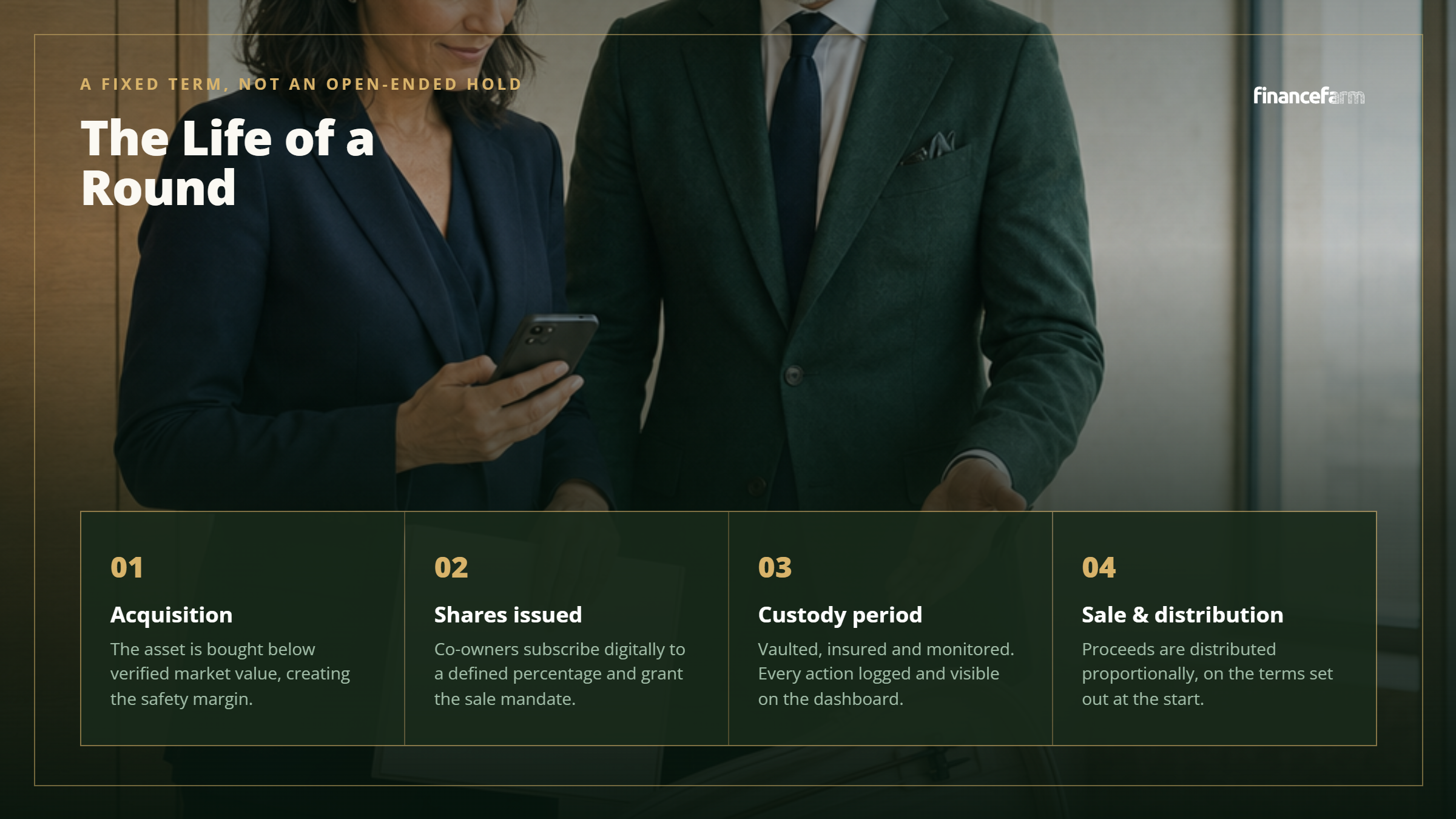
01 Assessment. Before anything else, the asset is examined. Valuation, provenance and condition are reviewed and documented. An asset that cannot be assessed with confidence does not proceed.
02 Acquisition. FinanceFarm acquires the asset from its owner through a structured private sale. The seller receives a firm purchase proposal, with no selling fees and no commission at sale, and 100 percent of the agreed price.
03 Custody. The asset moves into FinanceFarm’s custody and remains there.
04 Co-ownership. Ownership of the asset is held by several co-owners, each share set out in the contractual documentation.
05 Ongoing documentation. Every share, and every change of ownership, is documented.
Custody at FinanceFarm
Assets acquired by FinanceFarm are held in FinanceFarm’s custody. Switzerland has held high-value assets in secure custody for generations, and the standards are well established.
The Geneva Freeport is the world’s oldest and largest facility of its kind, with roughly 40 percent of its contents consisting of art, estimated at around US$100 billion in value. Works in such facilities are kept in museum-grade conditions, with humidity, light and temperature precisely controlled, behind armoured doors with biometric access, under strict chain-of-custody protocols.
A REAL OBJECT IN A KNOWN PLACE, HELD TO A DOCUMENTED STANDARD. NOT A CLAIM ON SOMETHING ABSTRACT.
Transparent Documentation at Every Step
Documentation is what makes a share meaningful. For every asset, the record covers what it is and its attribution, its provenance and ownership history, its condition at the time of assessment, the valuation and the reasoning behind it, where it is held, and how ownership is shared among the co-owners.
FinanceFarm AG has its seat in Switzerland and operates under Swiss law.
Frequently Asked Questions
Is the asset physically divided?
No. It stays whole and in one place. Only the ownership is divided into shares.
What exactly does a participant hold?
Genuine co-ownership in a specific, identified asset, set out in the contractual documentation.
Where is the asset kept?
In FinanceFarm’s custody, under controlled conditions with a documented chain of custody.
What does the seller receive?
A firm purchase proposal, with no selling fees or commission at sale, and 100 percent of the agreed price.
Start with a confidential assessment
If you own fine art, a luxury watch or a rare collectible and want to understand what a structured private sale would look like for your asset, the first step is a confidential assessment.
START SELLER ONBOARDING · www.financefarm.com
References
- Deloitte and ArtTactic. Art & Finance Report 2025, ArtTactic, 2025. arttactic.com
- Swiss Civil Code (SR 210), Article 646, Collective ownership: Co-ownership. Official bilingual text, in force since 1 January 1912. droit-bilingue.ch
- Swiss Civil Code of 10 December 1907 (SR 210), Fedlex, Federal Council of Switzerland. fedlex.admin.ch
- Lexology. ‘Borrowing against art collections’. lexology.com
- Blake. ‘Art-Secured Lending and Evaluating the Loan-to-Value Ratio in Art and Real Estate Lending Markets’, RANGE: Undergraduate Research Journal, 2023. uen.pressbooks.pub
- ‘Geneva Freeport’, Wikipedia. wikipedia.org
- Swssco. ‘Why the Ultra-Wealthy Choose the Geneva Freeport’. swssco.ch
FINANCEFARM AG · SWITZERLAND · LIQUIDITY FOR NON-BANKABLE ASSETS
This content is for informational purposes only and does not constitute financial advice. All participation in co-ownership carries risk.
Comments ()
No comments yet
Be the first to share your thoughts!