
Selling Art or Watches in Switzerland: What Will You Receive?
Selling Art or Watches in Switzerland: What Will You Receive?
A painting can have value without being easy to sell. A watch can make auction headlines without telling you what yours would fetch.
Before selling art, a luxury watch or a rare collectible, compare the amount you would receive, the conditions you must meet and when payment becomes due. An auction result, a valuation and a purchase offer answer different questions.
Does an auction result show what the seller receives?
No. A published result that includes the buyer’s premium is not the seller’s net proceeds.
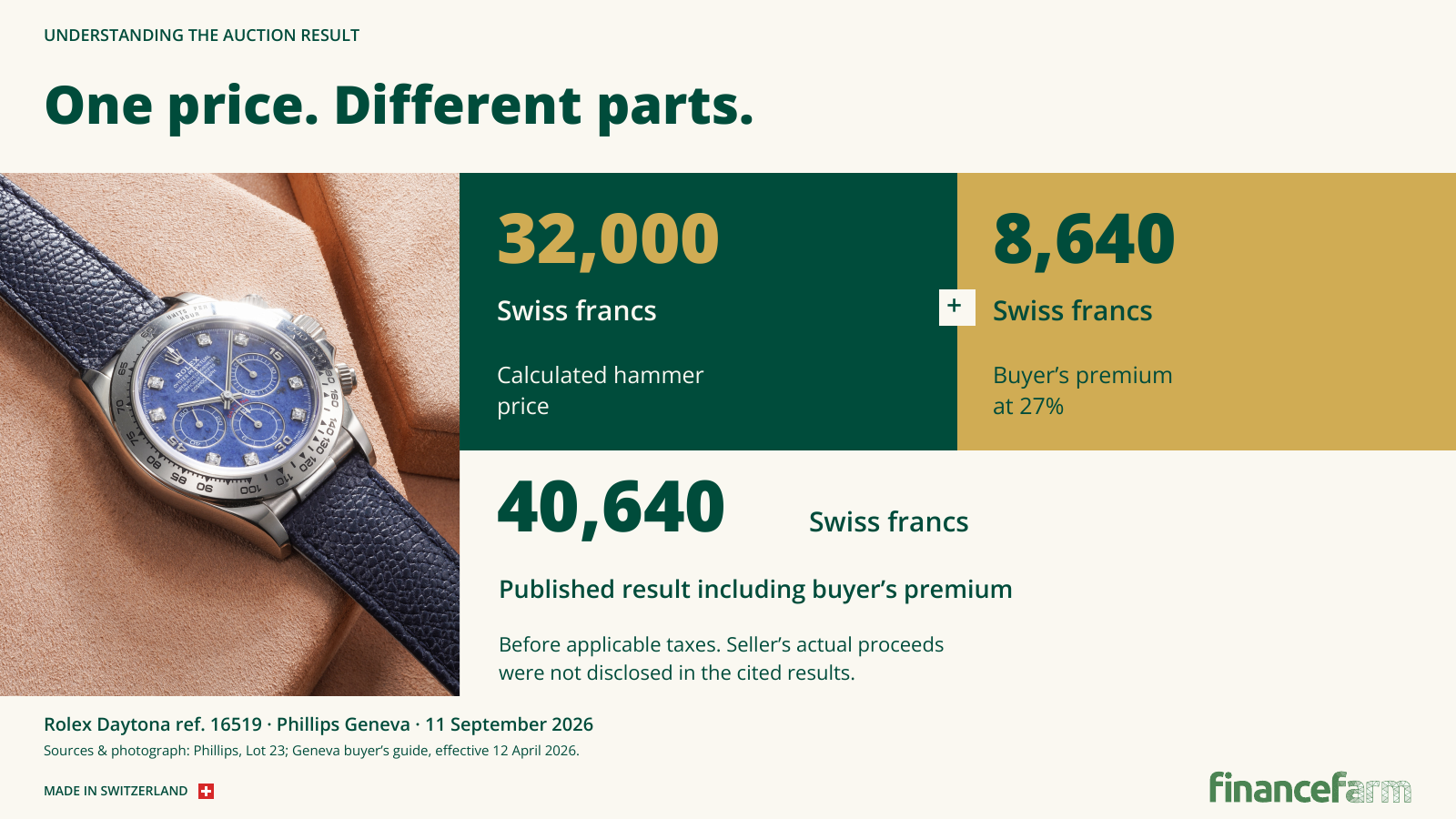
At Phillips’ Geneva Sessions on 11 September 2026, a Rolex Daytona reference 16519, lot 23, recorded 40,640 Swiss francs. Phillips’ official results include the buyer’s premium. [1]
Its Geneva watches guide lists a 27% buyer’s premium on the first 1.6 million Swiss francs of hammer price. At that rate, the published figure corresponds to 32,000 Swiss francs in hammer price plus 8,640 Swiss francs in buyer’s premium, before applicable taxes. This is a calculation from the published rate, not a disclosure of the seller’s account. [2]
The seller’s agreement determines commissions, expenses and any other arrangements. Their actual proceeds were not disclosed in the cited results.
When comparing an auction with a direct purchase offer, ask for a breakdown of what you would receive under each route. Also ask what happens if the auction lot remains unsold.
What should you ask before selling a painting?
Establish who is buying, who is acting as an intermediary and what must happen before you are paid.
On 17 September 2026, The Art Newspaper examined property reductions among major galleries, including locations in London and Basel. Its analysis distinguished business restructuring from failure. A gallery reducing its footprint does not, by itself, show that your painting has lost value. [3]
For an owner, the useful questions are practical:
- Is this a purchase offer or an agreement to try to sell the work?
- Which fees and expenses apply?
- Who arranges transport and insurance?
- What triggers payment, and what could delay it?
A consignment authorises someone to seek a buyer. It is not itself a completed sale. Compare the written terms before choosing your route.
Inside a FinanceFarm sale: what does the journey involve?
_1789723138871.png)
The following is an illustrative journey, not a customer testimonial or a completed transaction.
Imagine an owner who wants to sell an inherited painting. She starts by gathering photographs, dimensions, condition details and documents showing its history and ownership.
She registers with FinanceFarm, records the asset, then selects it to begin the sale process. Saving a record and submitting an asset for sale are separate actions.
FinanceFarm’s published seller flow includes a sales mandate, identity checks and review before the purchase-price and contract stage. Its published review criteria include ownership, authenticity, condition, provenance, and legal and customs status. [4] [5]
If the asset is approved for purchase, the owner receives a written offer with the price and terms. She can examine what she would receive and what she must do before deciding whether to proceed. An offer is not confirmation that payment has occurred.
The same preparation principle applies to watches and rare collectibles, although the evidence needed differs by asset.
What is FinanceFarm’s minimum asset value?
FinanceFarm’s published minimum assessed value is 25,000 Swiss francs. Meeting that threshold does not replace the asset review. [5]
Ready to explore selling?
Bring together your asset’s photographs, details and documents. Understand the proposed price, costs and payment conditions before making a decision.
Frequently asked questions
Does the auction result equal the seller’s payout?
No. A result including buyer’s premium is not the seller’s net proceeds. Seller commissions and agreed expenses can affect the payout. [2]
Who pays the buyer’s premium?
The buyer pays it on top of the hammer price. In this Phillips example, 27% of 32,000 Swiss francs is 8,640 Swiss francs, before applicable taxes. [2]
What should I prepare for FinanceFarm’s review?
Gather photographs, asset details and available documents about ownership, condition and provenance. Record the asset, then start the sale process. [4]
Does an asset worth 25,000 Swiss francs automatically qualify?
No. That is the published minimum assessed value; FinanceFarm must still review and approve the asset for purchase. [5]
What happens after approval?
You receive a written offer to consider. Check the price, terms and payment conditions before proceeding. An offer does not mean payment has occurred. [4]
Sources
- Phillips, Geneva Sessions results, 11 September 2026.
- Phillips, Geneva Guide for Prospective Buyers: Watches, effective 12 April 2026.
- The Art Newspaper, Tim Schneider’s analysis of mega-gallery property reductions, 17 September 2026.
- FinanceFarm, published seller workflow, accessed 18 September 2026.
- FinanceFarm, August in Review, 31 August 2026.
Comments ()
No comments yet
Be the first to share your thoughts!