
Which Assets Qualify? A Seller's Guide to Non-Bankable Assets on FinanceFarm
Not every valuable object qualifies for FinanceFarm. That is by design.
The platform was built to handle a specific category of assets: high value tangible goods that hold real, proven market value but sit outside the traditional financial system because banks refuse to accept them as collateral. These are called non-bankable assets. Luxury watches, fine art, rare collectibles, and selected raw materials. Items that trade actively through auction houses, private dealers, and specialist markets, but that have no standardised infrastructure for structured liquidity.
The combined global market for these categories runs well into the trillions. The Knight Frank Luxury Investment Index tracks ten categories of tangible collectibles and has documented consistent long term appreciation across all of them. A $1 million portfolio tracking the index since 2005 would be worth $5.4 million today. Luxury watches alone represent a secondary market built on over 600,000 verified transactions tracked by Chrono24's ChronoPulse index. Fine art auction sales at the three major houses peaked at $7.8 billion globally in 2022 before correcting to $4.1 billion in 2024, according to Knight Frank's Wealth Report 2025. Raw materials from gold to rare earth elements underpin entire industrial supply chains.
Yet despite all of this proven value, there is no single platform that lets a seller submit an asset, receive an evidence-based valuation, and walk away with a defined payout in a fully digital process. That is what FinanceFarm does. But not for everything. Here is what qualifies, what does not, and what you need to prepare before you submit.
Luxury Watches
This is the asset class with the strongest secondary market infrastructure, and it is the category where FinanceFarm's model fits most naturally.
The brands that perform best on the platform are the ones with deep, liquid secondary markets and well documented transaction histories. Rolex, Patek Philippe, Audemars Piguet, and Richard Mille sit at the top of that list. These are manufacturers whose output is constrained by production capacity, whose models trade at significant premiums above retail, and whose pricing can be verified through multiple independent data sources including Chrono24's ChronoPulse index, auction records from Christie's and Sotheby's, and dealer networks across Europe and Asia.
The long term trend for these brands remains strong. According to Chrono24's Q1 2025 market report, the secondary luxury watch market has grown 24.5% over the past five years despite short term corrections. Models like the Rolex Daytona, Patek Philippe Nautilus, and Audemars Piguet Royal Oak have deep enough transaction data to support FinanceFarm's conservative valuation methodology. That makes watches ideal for the D-6 rotation strategy, which operates on an approximate six month cycle. The asset enters the platform, co-ownership shares are offered to buyers, and the underlying watch is sold through verified channels within the rotation window.
What you need to submit a watch
Serial number and reference number. Purchase receipt or certificate of authenticity. Condition photos in defined slots as specified by the app. Service history if available. A clear description of any modifications, damage, or missing components. Complete box and papers will strengthen your submission, but are not always mandatory if other provenance documentation is sufficient.
Fine Art
Art is the second major category on FinanceFarm, and it behaves differently from watches in one important way: the marketing window is typically longer.
A watch with strong secondary market data can be priced, listed, and sold within weeks. Art often requires more time. The right buyer for a significant piece may need to be identified through a more targeted process, and auction seasonality plays a larger role. This is why fine art on FinanceFarm is often suited to the D-9 rotation strategy, which extends to approximately nine months and carries a higher target return to reflect that longer cycle.
The pieces that qualify are those with documented provenance and verifiable market value. That means exhibition history, catalogue raisonné references, gallery representation records, and comparable sales data from auction houses or private transactions. FinanceFarm is not looking for speculative emerging artists with no track record. The valuation methodology requires hard evidence, and for art, that evidence comes from how the work has moved through the market over time.
Contemporary and modern works with established auction histories are the strongest candidates. Think pieces that have appeared in reputable sales at Christie's, Sotheby's, Phillips, or major regional houses. Works by artists whose markets are tracked by indices like the Artnet Price Database or the Art Basel and UBS Global Art Market Report provide the kind of comparable data that supports a conservative, evidence-based valuation.
What you need to submit fine art
Provenance documentation tracing the ownership history of the work. Artist verification and authentication. A condition report, ideally from a qualified conservator. High resolution photographs from multiple angles. Exhibition history and any catalogue references. If the work has been sold at auction previously, the lot number and sale details will significantly strengthen the submission.
Collectibles and Raw Materials
This is the broadest category, and it is also the one where eligibility depends most heavily on the quality of available market data.
Collectibles on FinanceFarm include rare coins, precious stones, fine wine, and other tangible items where there is sufficient comparable transaction data to support a conservative valuation. The key word is sufficient. A one-of-a-kind item with no auction history and no comparable sales is difficult to value within FinanceFarm's framework, no matter how impressive it may be. The platform's model requires verifiable pricing, and that means the asset needs to have a market, not just a story.
Raw materials represent a distinct subcategory. These are physical commodities like gold, platinum, and rare earth elements where pricing is driven by industrial demand and geological scarcity rather than collector sentiment. Raw materials often have the most transparent pricing of any category on the platform because global commodity markets publish spot prices daily. For corporate and industrial clients, raw materials may fit the D-3 rotation strategy, which operates on an approximate three month cycle. For standard submissions, D-6 remains the default.
What you need to submit collectibles or raw materials
Certification from a recognised grading authority or assay office. Market comparables showing recent transaction prices for similar items. Condition documentation with photographs. For precious stones, an independent gemological report. For raw materials, proof of quantity, purity, and storage location. The stronger your documentation, the faster FinanceFarm can move through the valuation process.
What Makes an Asset Eligible
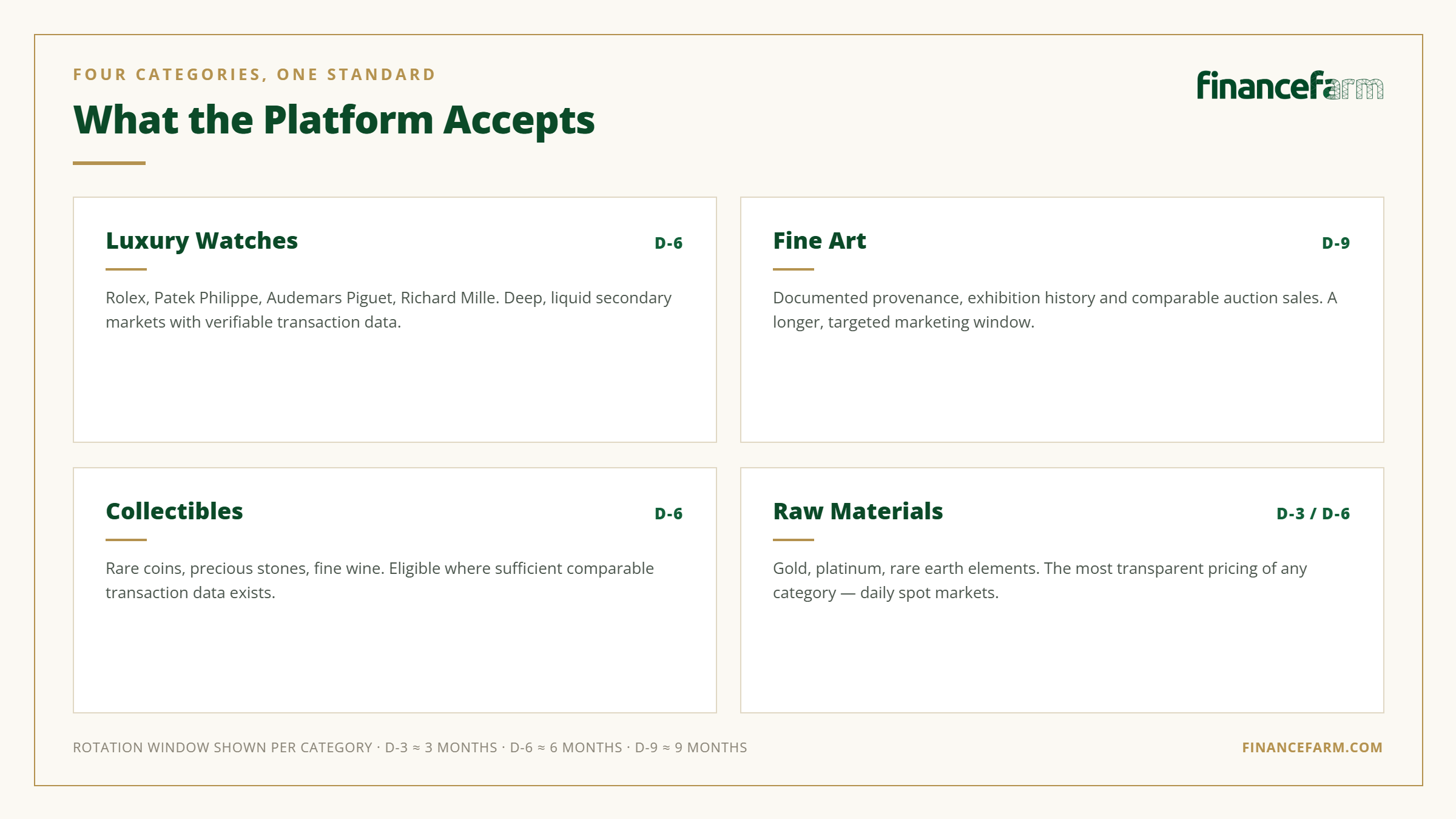
Across all categories, FinanceFarm applies the same set of principles to determine whether an asset qualifies for the platform. These are not arbitrary thresholds. They exist because the entire model depends on being able to acquire, value, and exit assets with a high degree of confidence.
Verified market value. The asset must have a demonstrable value supported by comparable sales data, auction records, dealer quotes, or commodity pricing. FinanceFarm's valuation team does not work with guesswork or optimistic estimates. If the data does not support a conservative valuation, the asset does not proceed.
Verifiable provenance and ownership. You must be the legal owner of the asset with full disposition rights. No liens, no third party claims, no legal encumbrances. You will be asked to e-sign declarations confirming this as part of the submission process, and FinanceFarm's compliance team verifies every file before anything goes live.
Adequate market data for conservative valuation. This is the critical filter. FinanceFarm applies a predefined minimum safety margin on every acquisition. That means the company only purchases when the price sits well below the most recent verified sale price. If there is not enough market data to establish that verified price with confidence, the deal does not happen.
Condition consistent with submitted documentation. Once you submit, your file is frozen as an immutable snapshot. When the asset is physically inspected, it must match what you described. If it does not, the process stops.
What Disqualifies an Asset
Some submissions will not proceed. Here is why.
Insufficient provenance. If the ownership history cannot be verified or if there are gaps in the chain of custody that raise questions, FinanceFarm will not take the risk. This is not a judgement on the asset itself. It is a compliance requirement that protects everyone involved.
No comparable sales data. If the asset has never traded in a verifiable market and there are no comparable transactions to anchor a valuation, the platform cannot apply its safety margin methodology. A unique item is not automatically a valuable one in the context of structured liquidity.
Legal encumbrances. If the asset is subject to a lien, a dispute, or any claim by a third party, it is not eligible. Full stop.
Items outside scope. FinanceFarm does not handle vehicles, real estate, or financial instruments. The platform is purpose-built for tangible, portable, non-bankable assets with established secondary markets.
How FinanceFarm Values Your Asset
Every acquisition is governed by a predefined minimum safety margin. This is the single most important rule in the entire process.
FinanceFarm will only purchase an asset when the acquisition price sits well below the most recent verified sale price for a comparable item. The valuation behind each acquisition is multi-stage and evidence-based. The team documents provenance, condition, and transaction history, then analyses auction results, dealer quotes, and comparable sales within a consistent framework. A proprietary valuation tool models historical price data, liquidity indicators, seasonal patterns, and exit paths before any purchase decision is made.
This means the margin potential exists before a single buyer participates on the platform. It is structural downside protection, not diversification. And it applies to every watch, every artwork, every collectible, and every raw material that enters FinanceFarm without exception.
For sellers, this translates into fast decisions and clear certainty. If your asset qualifies, you receive a defined offer based on evidence. There are no seller fees. No commissions. The price quoted is the price received.
What Happens After You Submit
The process runs through four phases, all in the app.
Phase 1: Submit. You create a case, upload photos and documents, provide provenance details, and e-sign your declarations. The system freezes your file as an immutable snapshot.
Phase 2: Valuation and agreement. FinanceFarm's compliance team reviews your submission against the frozen snapshot. If everything checks out, you receive an evidence-based offer and both parties e-sign the purchase contract in the app. A physical inspection confirms the asset matches your documentation.
Phase 3: Your asset goes live. Once compliance approval, signed contract, and confirmed inspection are all in place, your asset is listed on the platform. Co-ownership shares are offered to buyers who acquire fractions through the app. The participation round runs for a defined window.
Phase 4: You get paid. Payout is released only after the participation round closes successfully and funds from buyers have been received and reconciled. The payout goes through a multi-step internal approval process before it is executed and you are notified in the app.
There is also the buy-back option. If you sell your asset to FinanceFarm and later decide you want it back, you can repurchase it within the agreed window. The premium you pay covers the return earned by the buyers who held co-ownership shares in the meantime.
The Path for Each Asset Type
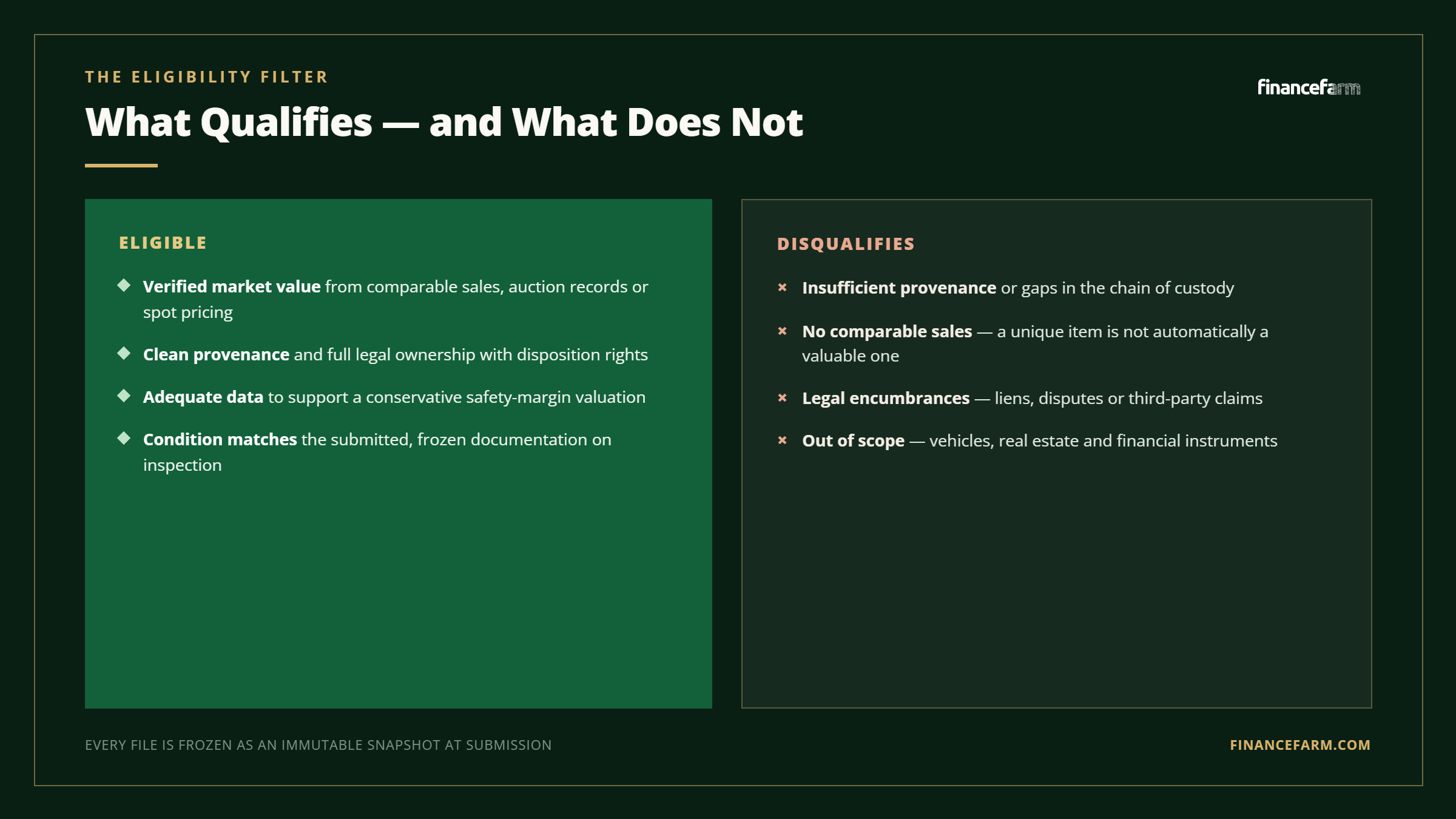
While the four phase process is the same regardless of category, the rotation strategy and typical timeline differ based on asset type.
Luxury watches typically enter the D-6 rotation. Strong secondary market data means valuation is fast, the participation round fills efficiently, and the asset is sold through established channels within the six month window. This is the highest frequency rotation available to individual sellers.
Fine art often suits the D-9 rotation. The longer marketing window allows FinanceFarm to identify the right buyer through auction houses, galleries, or private sales. The nine month cycle carries a higher target return, reflecting the additional time and the nature of the art market.
Collectibles and raw materials vary. Standard submissions from individual sellers typically enter D-6. Corporate and industrial clients with specific liquidity needs may qualify for D-3, the shortest rotation at approximately three months. The buy-back option is available across all categories for sellers who want to retain the right to reclaim their asset.
Think Your Asset Qualifies?
If you hold a luxury watch, a piece of fine art, a rare collectible, or a raw material with verifiable market value and clean provenance, FinanceFarm may be exactly what you have been looking for. No auction house fees. No opaque dealer negotiations. No predatory lending. Just a fully digital, evidence-based, audit-verified process that pays you a defined amount with zero seller fees.
The submission is free. The valuation is based on evidence. And if your asset qualifies, you could have a clear offer within days.
Submit your asset for a free evaluation.
Start at financefarm.com
FinanceFarm AG | Muttenz, Switzerland
This content is for informational purposes only and does not constitute financial advice. Target returns are based on the business model and are not guaranteed. All participation in co-ownership carries risk.
Comments ()
No comments yet
Be the first to share your thoughts!