
Bankable vs Non-Bankable Assets: The Difference, Explained Simply
Bankable vs Non-Bankable Assets: The Difference, Explained Simply
Look at your bank statement. Your savings are there. Your shares are there. Your pension is there.
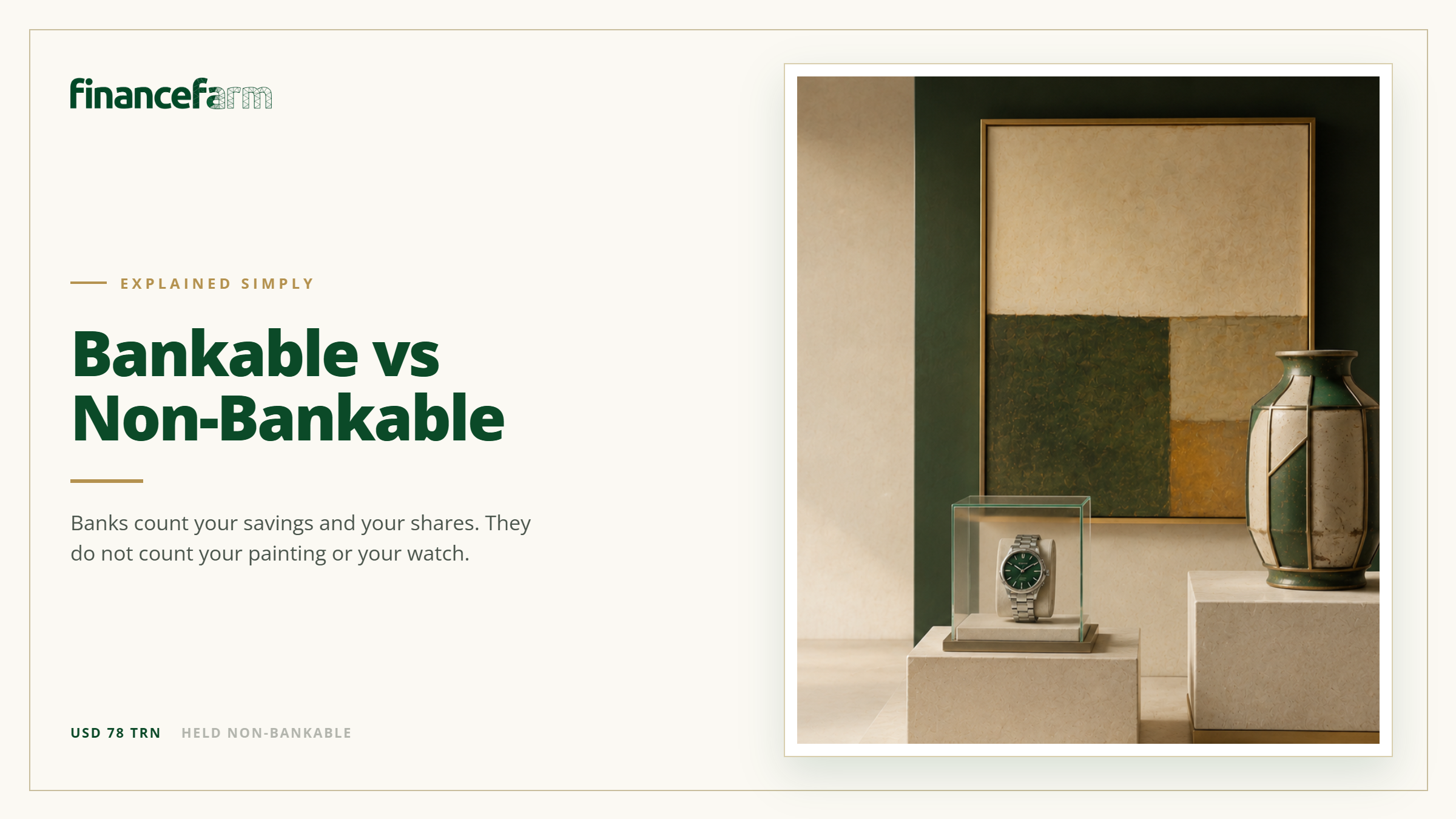
Now look at the painting on your wall. It is not there. Your watch is not there either.
That gap has a name in banking. One side is called bankable. The other side is called non-bankable.
The words sound technical. What they mean is simple, and it matters if you own something valuable.
What is a bankable asset?
A bankable asset is something your bank can hold for you, price every day, and show on your statement. Cash, shares, bonds and funds are all bankable. The bank can also lend against them, because it knows what they are worth this morning and it can sell them quickly if it needs to.
What is a non-bankable asset?
A non-bankable asset is a real thing you own that your bank will not hold, will not price and will not put on your statement. Art, watches, rare collectibles, private companies and property all sit in this group.
The banking software company Avaloq, whose systems are used across Switzerland, describes these assets as ones that sit outside a wealth portfolio, are often refused as security for a loan, and are hard to value and hard to trade. [1]
Non-bankable does not mean worthless. It is one of the most misread words in private banking. A painting can easily be worth more than the car in your garage. The bank simply has no way to carry it.
Why does the difference matter?
Because it decides whether you can use what you own.
A bankable asset is money with a delay of about two days. You sell the shares and the cash arrives.
A non-bankable asset is not. You cannot spend a painting. You cannot send half a watch to your builder. The value is real and the value is stuck.
This is the whole problem in one sentence. Your money is sitting on the wall.
How much wealth sits in non-bankable assets?
Far more than most people expect.
A study by Accenture and Orbium put global personal wealth at 260 trillion US dollars, of which 78 trillion was non-bankable. That is roughly thirty percent of everything people own, held in things banks do not carry. [1]
For art and collectibles alone, Deloitte and ArtTactic estimated that wealth held by the very wealthy stood at 2.174 trillion US dollars in 2022, and projected about 2.861 trillion US dollars for 2026. [2]
So this is not a niche. It is a large part of what people own, sitting outside the system that makes wealth usable.
Which non-bankable assets does FinanceFarm buy?
Three, and only three.
- Fine art. Works by established artists with a traceable record.
- Luxury watches. Pieces from recognised makers, with papers and box where you have them.
- Rare collectibles. Objects with a real collector market and documents showing where they came from.
We do not buy property, private companies, cars or musical instruments. If your piece is not in one of the three groups above, we are not the right buyer, and we will say so quickly.
How do you turn a non-bankable asset into money?
You sell it. That is the honest answer, and it is the only one we give.
An auction is one route. It can work well for the right piece. It also takes months, the costs are separate from the sale price, and you do not know what you will get until the day.
The other route is a direct sale. FinanceFarm buys for its own account. You send photographs and documents, we check the piece, and you receive a written offer valid for ten calendar days. If you accept and the checks are satisfied, we sign, you hand the piece over, and you are paid. [3]
There is no auction, so there is no hammer price and no bidding risk. There is no middleman, because the contract is with us directly. And there are no selling fees at sale.
Common questions
What are non-bankable assets?
Non-bankable assets are valuable things a bank will not hold, price or show on your statement. Art, luxury watches, rare collectibles, private companies and property are the usual examples. They are hard to value, hard to sell quickly, and usually refused as security for a loan.
What is the difference between bankable and non-bankable assets?
A bankable asset can be held by your bank, priced daily and sold within days. Cash, shares and bonds are bankable. A non-bankable asset cannot. The value is real, but you cannot spend it until you sell the object itself.
Are non-bankable assets worth anything?
Yes. Non-bankable describes how banks treat the asset, not what it is worth. Accenture and Orbium put the global figure at 78 trillion US dollars. The word describes the plumbing, not the price. [1]
Can I borrow against a painting or a watch?
Most banks will not accept one as security, which is exactly what makes the asset non-bankable. Where lending against art exists it is a specialist market with its own costs, and at the end of it you still owe the money and you still own the painting. A sale ends the problem instead of postponing it.
Which of my assets would qualify with FinanceFarm?
Fine art, luxury watches and rare collectibles.Paperwork matters more than category. An invoice, a certificate or an exhibition record is the difference between a fast answer and a slow one.
Your money is sitting on the wall. It does not have to stay there.
Open an account, add your piece with photographs and documents, then submit it for sale. A draft that is never submitted is never seen by anyone.
Sources
- [1] Avaloq, What are non-bankable assets?, citing the 2020 Accenture and Orbium wealth study. Retrieved 25 August 2026.
- [2] Deloitte Private and ArtTactic, Art & Finance Report. Retrieved 25 August 2026.
- [3] FinanceFarm AG, Seller Offer documentation, 24 August 2026
Comments ()
No comments yet
Be the first to share your thoughts!